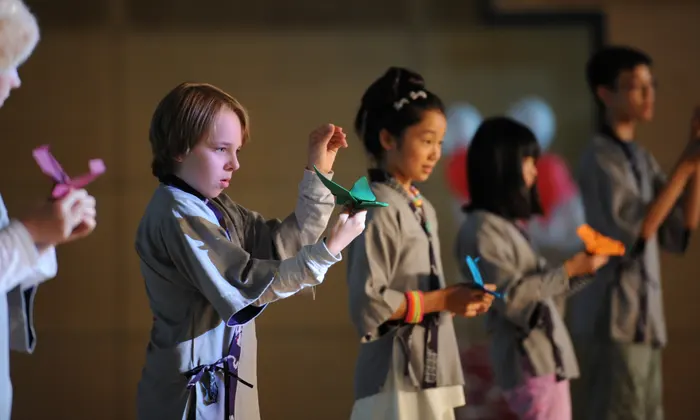
Paper Planes learning resource
It is something that everybody identifies with because everybody has made a paper plane.
Paper Planes is a heartfelt narrative about grief, relationships and the joy of creating something special. It tells the story of 12-year-old Dylan, a country boy with lots of energy and a passion for making and flying paper planes. After proving his paper-plane-flying prowess in the national competition in Sydney, he travels to Japan to compete in the world championship. For Dylan, winning is less important than being able to share his adventure with his father.
You can pay to download this inspiring and fun film from the website of The Australian Children's Television Association for educational use.
Recommended for Year levels: 3–6
Learning areas: English, Media
Paper Planes curriculum links
Before viewing
Exploring genre: What kind of film is Paper Planes?
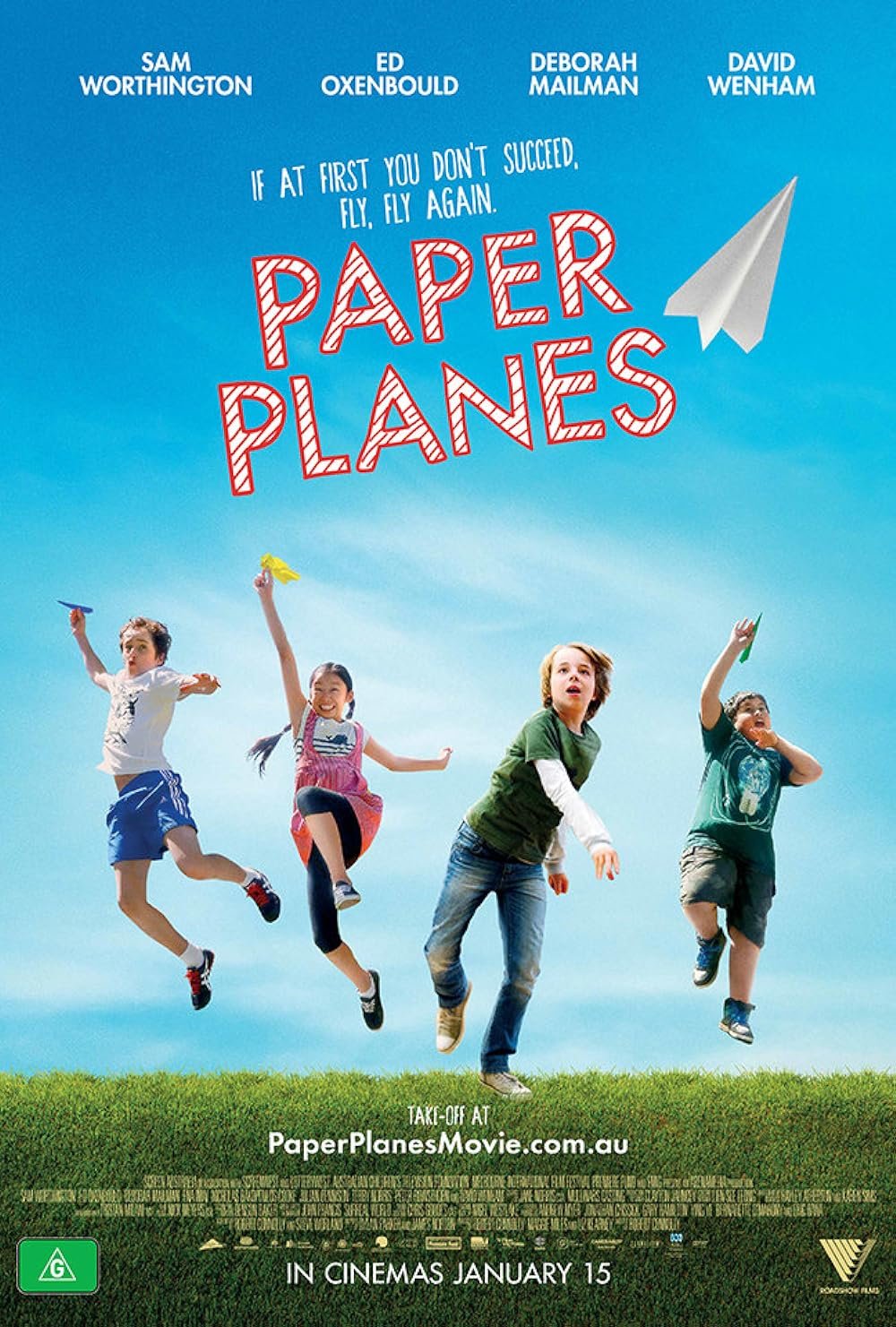
Look at the film poster (above).
- What is communicated about the film through the image used in the poster. Think about the colours used, the appearance of the characters and the way the characters are positioned in mid-movement.
- What about the catchphrase: "If at first you don't succeed, fly, fly again."? What does this suggest about the film's story and characters?
- Look at the design of the lettering used in the title. Why do you think this design has been chosen? What do you think it is communicating about the movie?
Watch the trailer (above)
- What do you learn about Paper Planes in the trailer?
- What kind of film does it lead you to expect? Explain which elements give you that impression.
- What are some of the techniques used in the trailer to ‘sell’ the film?
- Does it make you want to watch the movie?
- What age group/audience do you think the film is targeting?
The story behind the movie
Paper Planes was inspired by the real-life story of Dylan Parker and James Norton who were Australian paper plane champions. Dylan came third in the world championships. Dylan and James subsequently created a business called Paper Pilots that delivers paper plane-making workshops to young people. You can meet them in the first video (below) and in the second video (below) learn how to make a prize-winning paper plane. Give it a go!
- Have you ever made a paper plane? Did someone teach you how to do this? What paper plane design do you like best?
- Join together with your friends and create your own paper plane competition. Just start with the same size and kind of paper and see what you come up with.
- Make a record of the most successful designs and then think about the science behind the winning design. You can then compare your class’s experience with the designs that are most successful in the film.
- You can learn a bit more about the science and engineering behind flying a paper plane here.
After viewing
Getting started: your response to the film
Discuss with a partner:
- Which aspects of the film stood out for you?
- Which scene was the most memorable?
How did the story make you feel? Did it make you happy, laugh, angry, upset or sad? Why?
Film themes
- In groups think about the messages shared in the film. Join together as a class and share your thoughts. Explain using examples from the film.
- Make a list of the themes and ideas explored in the film. Give examples of where, when and how each of these themes and ideas was explored in the film.
- Join together as a class to discuss and extend your ideas.
The Paper Planes narrative
Narrative is another word for story and the way a story is told. In films, the narrative is communicated through many different features that are just as important as the dialogue spoken by the characters. Elements or features in film narratives include: camera shots, lighting, sound, music, acting, costumes, setting, set design, props and editing.
To begin thinking about these features, it can be helpful to look closely at particular scenes and think about how the narrative is being communicated.
- Watch the clip (above) and then work with a friend to identify the narrative features.
- Use the worksheet (below) to help you organise your ideas. Before getting started, you may like to visit our Film It resource to learn a bit more about how to discuss camera shots.
Narrative structure
Film narratives are usually organised into three sections, beginning, middle and end.
Beginning – The main character (protagonist) or characters are introduced at the beginning of the story. In Paper Planes the main character is Dylan.
- How is he introduced?
- What other important characters are we introduced to in the beginning?
Middle – A complication or problem arises that must be resolved/worked out.
- What are some of the problems Dylan faces?
End - The story concludes as the problem is solved.
- How does Paper Planes end?
- Were you surprised by this ending?
- Share ideas about how else might the film have ended.
- What do you think is going to happen next in Dylan's life?
There are 2 main stories in Paper Planes: Dylan’s attempts to win the paper plane championship and his relationship with his father.
- How does the ending bring these two stories together?
Plot
Plot describes the events that keep the story (narrative) moving.
- What are the main events (plot points) in Paper Planes?
- Divide into groups and identify these key events.
- Try to be precise and concise, so you only list the main plot elements as a summary. Putting together this kind of summary is challenging and is a great skill to develop.
- Compare your findings and then try to come up with a whole class description of the plot.
Young people as heroes
Robert Connolly made this film because he wanted to tell a story where young people were at the centre of the action. He wanted it to be a film "for kids about kids".
- Name some other live-action films where the kids the heroes.
- Make a list as a class.
- What similarities does Paper Planes share with these films
- How is it different?
Characterisation
Dylan – the protagonist/main character
- How would you describe Dylan? (Brainstorm as a class with single words to get the discussion underway.)
- Is he a successful main character?
- Do you care what happens to him? Explain and give examples.
- What do we learn about Dylan as the story unfolds? What does he learn about himself? What does he learn about others? How has his life changed by the end of the story?
- Use the prompts provided on the sheet(below) to track the development of Dylan's character over the course of the narrative.
Other characters
- As a class, make a list of other significant characters in the film.
- Working in small groups, choose a different character for each group to explore. Focus on the key features of this character and his/her role in the story.
- Use the Character Development sheet to guide your response.
Themes
Creativity and imagination
Kimi tells Dylan that winning is not important but rather “It’s about making something beautiful and surprising.”
- Discuss this idea as a class.
- Do you agree? Explain your answer.
- Take a moment to think about something you have made, done or experienced that was beautiful and surprising.
Overcoming challenges
- What challenges does Dylan face?
- Considering these challenges, why does the paper plane competition become so important to him?
- Dylan’s story has a happy ending. Would it still have been a happy ending if Dylan’s plane had not flown the furthest? Explain.
Community
Dylan has an enormous amount of determination but he needs help to follow his dream.
- What are some of the ways Dylan finds help and support?
The international competition is more about bringing people together than it is about winning and losing.
- What does Dylan learn from his time in Japan?
- What about Jason? How would you describe his attitude to the paper plane competition? Do you think he has more of a sense of community by the end of the narrative?
Bullying
Dylan is bullied by two different boys during the story.
- How does Dylan deal with each of these situations?
- Why does Kevin accept Dylan’s offer of friendship but not Jason?
- What does this tell us about Kevin?
- What does it tell us about Jason?
- Why doesn’t Dylan report Jason for his violent behaviour? Do you think Dylan makes the right decision in this case? Explain your answer.
- Imagine you are Dylan’s friend and want to help him out. Visit the Bully Stoppers website where you will find information to help when you or someone you know is being bullied.
- In groups, consider the best way for Dylan to respond to Jason’s bullying. Share your ideas as a class.
Further Activities
Championships
Now that you have seen the film, spread the word about how much fun it is to fly paper planes.
- Hold a whole school paper plane competition with the following categories
- best flyer – longest distance
- best flyer – longest time in the air (aloft)
- most unusual design
- most beautiful design
- funniest design
- Before launching your planes: Give everyone the chance to predict which plane will fly the furthest and which will stay in the air the longest. Share why you make the predictions you do.
- After the competition: What factors contributed to the success of the winner?
Celebrating Surprising Skills and Talents
- Dylan's mother taught him how to make paper planes. What skill or talent has a friend or family member shared with you? Maybe you could pass it on by sharing it with someone in your class.
- What unexpected (or silly) skill or talent do you have or wish you had?
- What kind of competition could you create around this skill or talent?
Read the novel
Did you know Steve Worland adapted the film into a novel?
- Read the book and find out more about the similarities and differences between the book and the film by working through this Paper Planes Novel and Film Comparison resource.
© This resource has been published under licence from the Australian Children’s Television Foundation.