
Good News: Information and media literacy resource
Welcome to this ACMI resource developed for Media Literacy Week. This resource is all about the news, news programs, sources, opinion vs. news, bias and more.
Recommended for Year levels: Year 5 & 6
Learning areas: Media Arts, English, Ethical
The news
What is news anyway?
We all understand what it is, but it can be a bit hard to define in words!
Have a go: pair up and tell your partner how you would describe what 'news' is. Then let them have a turn.
News is recent events or information we consider worthy of being covered by news outlets.
So for news to be newsworthy (worthy of the being covered by those who bring us the news), it needs to be new enough or interesting enough to be covered in the news.
There are lots of 'news' outlets, including magazines and websites dedicated to speciality areas (film news, videogames news, fashion news etc) but let's focus on news programs, the ones broadcast on the television in the evenings (often 6pm or 7pm).
Nowadays of course, we can catch up on these news programs via streaming or find recordings of these programs or segments/news stories online as well.
Question: who decides what is newsworthy? Have a brainstorm in a group or as a class.
It's a really interesting question, and there are two answers. So the people producing the news programs decide what stories will make their lineup of stories will have a big say.
But the audience also plays a part, news programs aren't usually going to cover stories they don't think people will be interested in. They may decide this due to a feeling or instinct about their audience, but they might have viewership data or audience research to draw upon as well.
Local news and segments
In Australia, all our free-to-air commercial and non-commercial networks have evening news programs, and most have local news programs.
Commercial channels are ones that have advertisements and run like businesses. Non-commercial channels (like the ABC) are funded by Government and don't need to sell ad space to fund themselves. SBS is unique in that it Government funded but also helps fund itself through ads as well.
Local just means that channels like the ABC and the commercial networks like 7, 9 and 10 all have news programs filmed in each or most of Australia’s capital cities.
So these are local to the city, State or Territory.
SBS has a World News program which is the same program Australia-wide as it focuses on Australia and the world, rather than local news in Melbourne, or Brisbane for example.
The local news programs will cover world and national news of course, but they will have lots of stories about things happening in their State or Territory, things happening in local towns or cities. Events that the local audience will want to know about or find interesting to learn more about.
Research: in a pair, group or as a class, do some research into local news programs.
| Victoria | NSW | QLD | South Australia | Western Australia | Northern Territory | Tasmania | A.C.T | |
| ABC | ||||||||
| Ch7 | ||||||||
| Ch9 | ||||||||
| Ch10 |
Extra research: Find out if these news programs can be viewed outside of their TV broadcast times; so can you stream later or watch online in some other way?
Segments
Even though there are lots of different local news programs being produced by a number of TV channels, they often have similar and recurring segments.
A segment is just a part of the news program. You can probably guess some of the segments you will see nearly every time you watch a local news program, regardless of the channel!
Question: as a class, brainstorm the types of news segments you would normally see on the news.
Teachers:
Responses you get will probably include things like: the weather, sport, entertainment and so on. World news, local news, crime or even finance might be some other responses. It doesn't happen quite as often as it used to, but news programs commercial and non-commercial would end their programs with 'feel-good' stories.
As well as news presenters (sometimes known as news anchors) hosting the show, other specialists might also present in some segments such as the weather or sport.
You might like to see what happens when the weather presenter isn't actually present in the video below when Tony Armstrong who was presenting sport, decided to jump in for the absent weather reporter:
Good reporting
News reporters bring us news stories, and also interview people for news stories as well.
Think:
- what kind of qualities do good reporters have?
- what does good reporting look like and sound like?
- what kind of qualities do good interviewers have?
- what does a good interview look like, sound like, and feel like (for the person being interviewed?
Teachers:
See what ideas students come up with.
To report the news, we think people need to speak clearly and confidently, be good at gathering information, and getting that information across.
Good interviewers will have similar qualities, but they should also be good listeners, always seem interested in what the people they are interviewing are saying (so don't look bored or disinterested!)
Good interviewers leave comfortable distances between them and the person they are interviewing, they don't shove microphones in anyone's face, they face the person they are speaking to.
They might look the person in the face or maybe not if that's uncomfortable for the person being interviewed.
They will speak clearly and make the person being interviewed feel comfortable.
Activity: do some drama role play with students in groups of 3-5. Students should be comfortable with each other and be prepared that they are going to model bad interviewing and reporting for fun.
Set roles (interviewer, interviewee, and prompt person) give students a topic to pretend to be reporting/interviewing someone about.
Students start their report, and the prompt person introduces the prompts mid-report to keep things light and silly.
Prompts:
Show us...
- a reporter who doesn't know where the camera is
- an interviewer who doesn't understand personal space
- an interviewer who is really tired and can't hide it
- an interviewee who only gives 'yes' or 'no' answers
- a reporter who talks too fast
Sources
When we talk about news events, sources are usually people - they are where the information is coming from for a news report or news story.
There are two types of sources.
Primary, and secondary.
Primary sources
A primary source is someone who was there, is directly impacted or involved, or maybe an expert in the field related to the story.
When reporting on something newsworthy, you want to stick to the facts, and use primary sources where you can.
Witnesses are definitely Primary sources, but not all Primary sources need to witnesses.
Secondary sources
A secondary source might be someone who wasn’t there, is not connected or directly affected by the event, and may instead be providing an opinion about what has happened.
So maybe in the crime story, it’s someone who lives the next suburb over, who wasn’t there, didn’t know the people involved, aren’t victims of robbery themselves; saying "I never thought something like this would happen so close to home!”
Great examples of news stories that involve lots of secondary sources are ones that involve 'vox pops'; so asking random people their thoughts on an event, or issue.
Think of it like this: Primary sources help us understand the event and get a better picture of what happened, secondary resources are people that aren’t going to shed much light on the event and will give us their feelings or opinions about what has happened instead.
Watch the below video from Behind the News on sources, made by our friends at the ABC:
- What’s the main difference between an opinion and an expert opinion?
- Is one expert opinion good enough? Or should they be backed up by other experts?
- Can there be experts who disagree? If so, should reporters try to show both sides of the debate from experts on both sides? Or just one?
- What is false equivalence?
News vs. opinion
Good reporters and journalists, and the news outlets they work for, tend to make it clear when what they are presenting is news, or an opinion.
However, a news program or television network might present a point of view, or opinion on something, in other less obvious ways.
For example, choosing to cover certain stories and not others.
Videogames are a great topic to us help think about this because, depending on what channel you are watching, or news outlet you are reading, you might find different attitudes towards videogames.
Let's say one day, there were three local stories about videogames.
- One news item is about a young person becoming ill after playing videogames for way too long.
- Another is about a university report indicating that some videogames can be good for people’s mental health.
- The other news story is about a video gamer winning a lot of money at an esports competition.
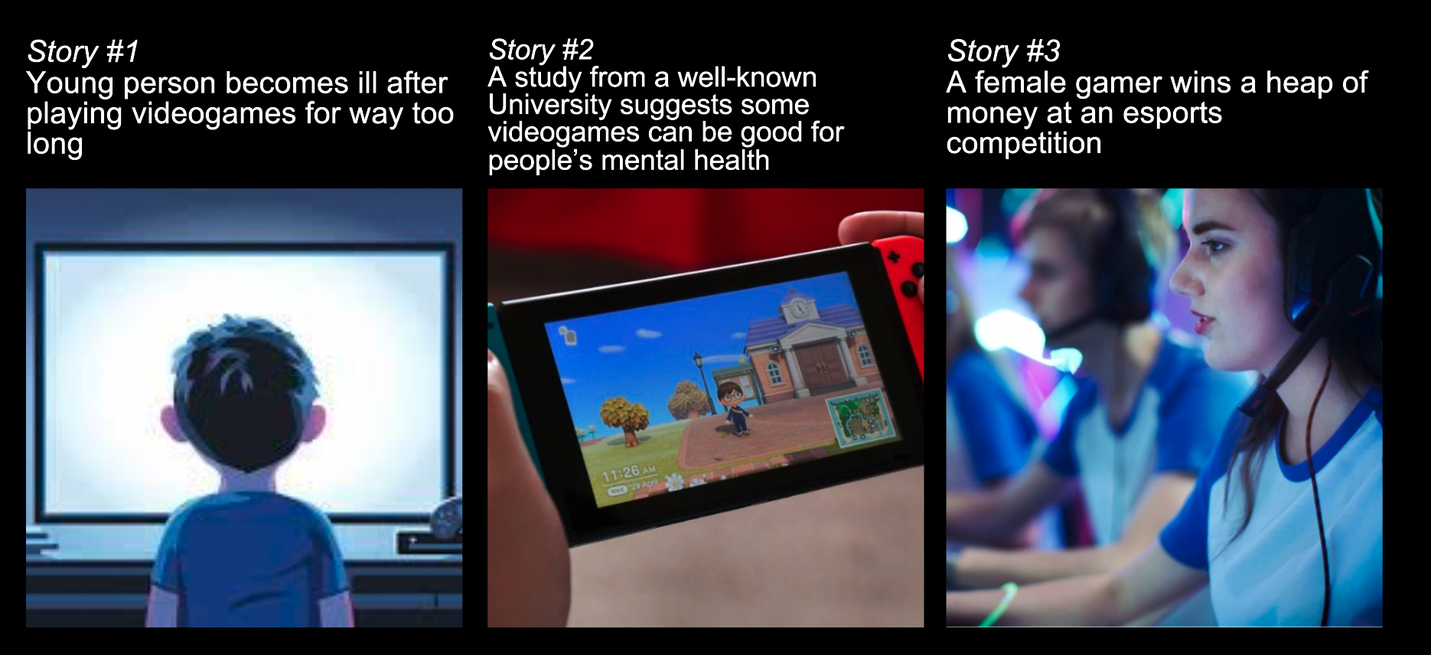
Let's say there are three news outlets reporting on these stories.
Let's say:
News outlet A only covers the first videogames story, about people becoming ill.
News outlet B covers the university report and the esports winner.
News outlet C covers all three stories.
- Q: What does it say about outlet A that the only covered the negative videogames story?
- Q: What does it say about B that they only covered the positive vidoegames stories?
- Q: What does it say about C that they covered all three stories?
Bias
By only covering certain stories, and not covering others, news shows might show they have a bias about a topic or issue.
As we can see from the activity above, A showed they might have a bias against videogames.
B showed the might have a bias for videogames, but outlet C showed they don't have a bias, or are being objective about the topic of videogames.
When a person or a group, or organisation have strong feelings about a topic or issue that they can’t put aside when reporting or putting news stories out there, we call this ‘bias’.
Instead of sticking to the facts, they bring in their opinion. This bias is influenced by a personal connection or a strong opinion on the topic being reported on, and this might show when they report on the topic.
Language and reporting
How we report on a news story, and the language we use, can also influence how an audience might view that story too.
Let’s consider story number three, a person winning half a million dollars at an esports competition.
Here is a made-up headline for this story - and remember, TV news stories can have headlines too. We often see them next to or behind the news anchor - what do you think?
Game-addict takes home a steal
Question: Would you say this is a negative, neutral, or positive headline?
Teachers:
Discuss some of the connotations of the words in the headlines, and what associations students make with the words 'addict' and 'steal' especially.
Here is some more information, or 'facts' about the story.
Juliet Manford was the woman’s name
- She’s 20 years old
- She works part-time job and also juggles an esports career.
- She admits she probably games too much, but that it has paid off for her
Activity:
With this information, try and write a more neutral or balanced headline for this story, by a neutral headline we mean one that communicates what the story is about but doesn’t try to tell the reader or viewer how to feel about the story through negative or positive language.
You could also try writing a really positive headline too if you like! Hone in on those negative words from the original headline, and see if you can include more positive ones instead.
Creating your own news segment or program
Camera
What will you use to film? If your school doesn’t have fancy video cameras lying around then iPads and tablets work great.
We recommend getting either a tripod or a monopod so you can film stuff steadily (camera shaking and moving makes people a bit ill!)
Filming tip: it’s always good to consider the lighting where you are filming. You don’t need a portable light, you can just use the natural light, and whatever light or lights are indoors if you’re filming indoors.
If you’re outside, try and have natural light facing who you are filming. This will help prevent shadows and silhouettes.
If you are indoors, don’t film people against windows that look outside, because that natural light behind them will cause silhouettes. If there are lights on in the roof or around the space, move around a bit until you can see your subjects clearly.
Microphones
iPads and most video cameras have in-built microphones which often work fine. But they don’t have great range, so you should film relatively close (maybe within 2 metres) to ensure the microphone picks up what people are saying.
If you’re outside and it is windy, try to find a place where you are protected from the wind because wind can really interfere with microphones.
If you can get access to a microphone, great! Many will plug straight into your camera or tablet, but sometimes you need an adapter. If you do plug in a microphone, always film a test and check it is working first! You can then either position the microphone near the people who are talking, or your reporter holds it in their hand (and makes sure they point it at who they are interviewing too!)
Editing software
How will you edit your news report?
Often iPads come with iMovie built in which is good! Otherwise iMovie is also free for Apple computers, and there's also OpenShot Editor for PCs.
Green screen
If you have access to a green screen at school, great! They can be a lot of fun and sometime it can be good filming in a controlled environment where you can set up good lighting, you don’t have to worry about wind, and you don’t have to lug equipment around.
Try and use green screen when you think it’s a good idea, not just for the heck of it!
If you do want to use green screen you’ll need a background to edit in (this is called ‘keying’) and it should be a high-resolution image or video footage.
You will need editing software, the good news is free programs like iMovie have the ‘keying’ tool.
What happens is the keying tool in the editing software removes all the green, and you layer in your background image or footage behind the footage of your interview or report, so that image or footage appears instead of the green.
Filming cutaway footage
You can of course film an interview, and play it back exactly as it was recorded. However, you might like to film what we call ‘cutaway’ footage. This is footage that relates to the story or the interview that you can edit in, or ‘cutaway’ to, over parts of the report or interview.
This footage can make the story more visually engaging and can also cover up awkward ‘cuts’ or edits in the interview.
Good luck!
Good luck on your news reporting journey, we hope you've learnt a bit more about the news, both watching it, and making it.