The Holdovers - Characters
Paul Hunham
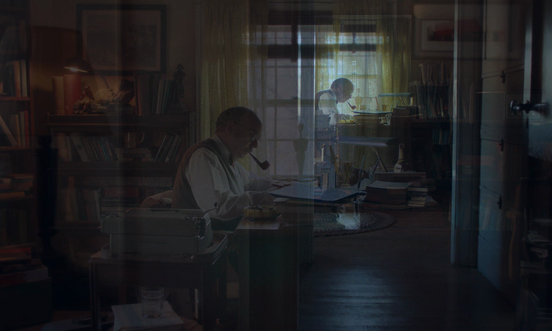
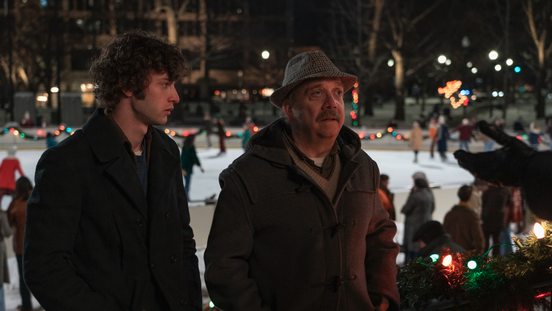
At the beginning of The Holdovers, following the opening images of school life, Payne shifts to a series of still, carefully composed shots of Hunham’s private space: a pipe resting in an ashtray, a narrow single bed, a cluttered bathroom, a shaver beside haemorrhoid cream. These intimate details construct an indirect portrait of Hunham, suggesting a life defined by routine, solitude and ageing before he even appears on screen. The first shot of Hunham is through a doorway and builds on this introduction. He is marking student work at his desk, and a wide shot from inside his study reveals his tense body language and impatient scribbling. The midshot that follows moves in close enough for viewers to hear him muttering “philistines, lazy, vulgar, rancid…” signalling his disdain for his students.
Subsequent scenes build a picture of an irritable and anti-social curmudgeon. Hunham’s reluctance to open his door and his failure to appreciate Lydia’s gift of Christmas cookies illustrate his social withdrawal. He is also shown in conflict with Principal Woodrup, who hasn’t forgiven him for failing the son of a senator, who is also a school donor. In Hunham’s refusal to bow to the pressure to pass this student, he comes across as principled and obstinate in equal parts, with neither attribute working in his favour. His declaration that “we cannot sacrifice our integrity at the altar of their entitlement…” demonstrates his command of language, but also its tendency towards hyperbole, as he casts the disagreement in moral and almost religious terms. He frames the conflict as a battle between integrity and entitlement, highlighting both the seriousness with which he regards academic standards and the self-righteous rigidity that alienates those around him.
There is also the suggestion that, as well as lacking the Woodrup’s respect, Hunham is unpopular among his colleagues. When the dolly shot through the dining hall lands on two teachers in discussion (one having evaded ‘holdover’ duty through a lie), neither seems particularly troubled that the responsibility has instead fallen to Hunham. One comments with dubious sympathy: “That poor walleyed bastard”, a dismissive slur referencing Hunham’s lazy eye.
There is also little love lost between him and his students. In the only scene where Hunham is shown teaching a class, the disdain he has for his young, entitled charges is clear. He is quick to insult them through his intellect and sarcastic turn of phrase:
Teddy: “I can’t fail this class!”
Hunham: “Oh don’t sell yourself short Mr Kountz, I truly believe that you can”
As he drops low-marking exams onto students’ desks, he appears almost gleeful, whistling ‘The Ride of the Valkyries’ in accompaniment to several shots of poor marks followed by reaction shots of students and their disappointment. The contrast between his upbeat whistling and their responses highlights his lack of empathy and abrasive demeanour, and points to the petty satisfaction he draws from the authority he is able to exercise over them. His response to the students’ dismay sums up his attitude to teaching: he sees their underperformance as entirely their fault, rather than reflecting any shortcomings he may have as a teacher.
Even when he considers allowing a resit of the exam after the break, it comes with the condition that it will cover entirely new content, requiring students to study over the Christmas break. Then, when Angus questions Hunham’s decision to introduce a new topic in the final minutes of term, Hunham responds by withdrawing the offer of a makeup exam. He relishes the opportunity Angus has given him to refuse to concede any ground to these privileged students. Instead, he seems to make it his mission to place academic hurdles in the way of these young people and the privileged lives laid out for them. He does this under the guise of upholding the learning standards instilled into him during his time as a student at Barton Academy under the tutelage of former school principal Dr Green.
Hunham: “As Dr. Green used to say, our one true purpose is to produce young men of good character”
Hunham disguises his disdain, dissatisfaction, frustration and unhappiness as adherence to the late Dr. Green’s teaching philosophy, rationalising feelings that he does not yet admit to himself. At this stage of the narrative, his rigidity is a form of self-concealment. This same pattern extends to his personal life, with him hiding his loneliness behind denial. He tells Mary:
Hunham: "I like being alone. Always found myself drawn to the ascetic. Like a monk. The foregoing of sensual pleasure for the achievement of spiritual goals.”
That this ascetic life includes drinking booze from a coffee cup all day and into the evening reveals a gap between how he describes himself and how he actually lives.
As the narrative unfolds, viewers learn more about why Hunham is unhappy and dissatisfied. He was a scholarship boy who then failed to achieve his potential due to a scandal that saw him expelled from Harvard. Barton has become both his only refuge and a place of last resort, something he feels more acutely under the leadership of Principal Woodrup, a former student. Within this context, Hunham’s resentment of his privileged students is not only professional frustration, but also a projection of his own stalled trajectory and sense of exclusion from the academic success he once expected to have.
His feelings of stagnation are reinforced by how others perceive him. Mary recalls Curtis describing Hunham as “a real asshole”, a description Hunham is prepared to acknowledge. Curtis was a scholarship student, and his critique cannot be dismissed as entitlement or privilege. Instead, his comments are further evidence Hunham has lost his way as a teacher. Hunham tells Lydia that he was once inspired by Dr Green’s view of what could be achieved through education:
Hunham: “I guess I thought I could make a difference…. provide standards and grounding like Dr. Green always drilled into us. But, uh, the world doesn't make sense anymore”
However, any belief that he could instil ‘standards’ or ‘grounding’ through his teaching has clearly faded, and he now perceives Barton as a microcosm of a broader society ruled and manipulated by powerful and wealthy individuals.
Through his tentative friendship with Mary and developing relationship with Angus, Hunham is gradually drawn out of the narrow, self-protective perspective that has sustained his bitterness and isolation. In listening to their experiences and revealing aspects of his own past, he begins to engage with others more openly and empathetically – qualities long absent from both his teaching and personal life. The film suggests that Hunham’s disappointment and sense of failure have trapped him within his own grievances, leaving him unable to see beyond them. By the conclusion, his sacrifice for Angus becomes transformative, not only because it helps Angus, but because it finally frees Hunham from the emotional and institutional stagnation that has defined his life at Barton.
Questions for analysis
| 1 | To what extent is Hunham’s hostility towards his students driven by principle rather than personal disappointment? |
| 2 | In what ways does Hunham disguise or deflect his unhappiness? |
| 3 | How is Hunham trapped at Barton and in life, both through circumstance and his own doing? |
| 4 | How does The Holdovers chart the changing relationship between Hunham and Angus, and why is Hunham ultimately willing to sacrifice his position for him? |
| 5 | How do Hunham’s relationships with Mary and Angus transform his understanding of himself and others? |
Angus Tully
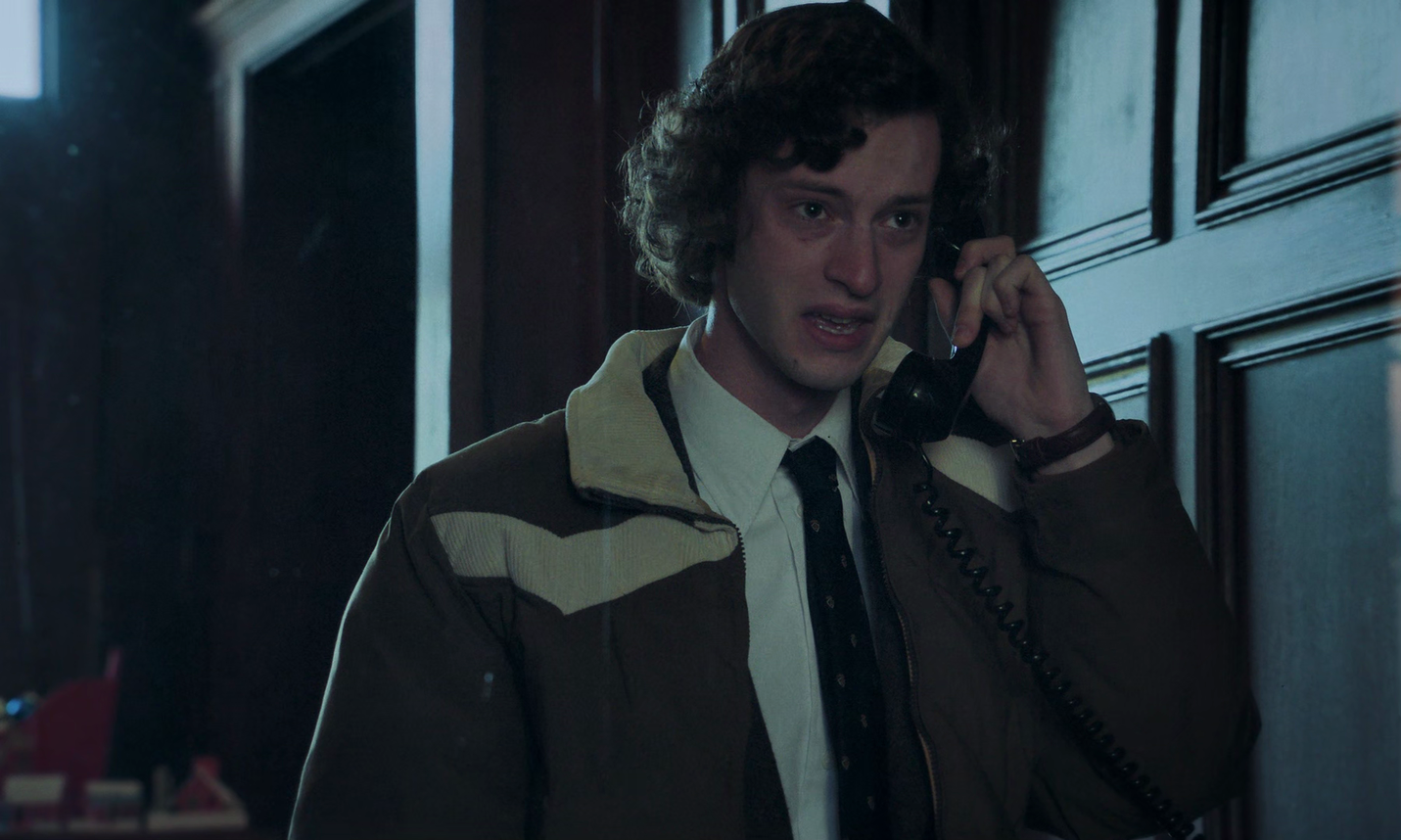
In his first scene, Angus could easily be mistaken for yet another entitled Barton student, standing out only for his prickly, combative attitude toward both peers and teachers. He immediately locks horns with Kountze (the failing student) and comes across as smart-mouthed and superior. In the classroom scene, although it is Kountze who is initially most vocal about his disappointment regarding his exam result, it is Angus who makes the unwise decision to challenge Hunham about introducing new content in the final class of the term. As this exchange plays out, the framing and shot choice communicate the growing tension between Angus and Hunham.
Following a wideshot that includes Hunham and the class, a wideshot from a different angle reveals Angus framed by his classmates. His hand is raised and, with absolutely no encouragement from Hunham, he states that the decision to begin a new topic is ‘absurd’. Once he challenges Hunham’s authority, the space is collapsed between the two characters. Hunham steps forward ever so slightly towards Angus, and both are framed in a series of tight midshots that emphasise their growing battle of wills. While some shots include Kountze and other students, the framing keeps Angus at the centre of the conflict while subtly reminding us that Hunham's decisions affect more than just one student. Just as this scene exposes Hunham’s bitterness and tendency to take out his sense of failure on his students, it reveals Angus’s cockiness, impulsiveness and isolation within the student cohort. Despite Hunham's tear down of Angus, the fact he engages Angus is in contrast to the way he dismissess Teddy Kountze. It suggest a begrudging respect for Angus and his intellect, after all, we know Angus received the highest mark, so Hunham's willingess to actually engage Angus in debate indicates Angus is at least somewhat worthy of Hunham's attention.
It also communicates Angus’s excitement about the coming holidays, which adds to the viewers’ understanding of the depth of his disappointment when his trip is cancelled and of how much his bravado and rebelliousness are a cover for deeper feelings of loss and rejection.
Subsequently, in the scenes between Angus and the other students left behind at school over the holidays, his smart-alec arrogance is tempered by a capacity for empathy. This is evident in his response to Kountze’s bullying, including his recognition of how cruel it was to throw Alex Ollerman’s glove into the river, and in his kindness towards Ye-Joon Park after he wets the bed. Perhaps because of his own troubled history, Angus reveals a more generous side to his character when people are in trouble. For instance, when he is taken to hospital with a dislocated shoulder sustained in the ‘off limits’ gym, he fabricates a story that will help Hunham avoid trouble with Woodrup. However, rather than being grateful, Hunham asserts the Barton ethos that “Barton men don’t lie”, and Angus responds by telling Hunham that he now “owes” him, clearly pleased with the advantage this gives him, an exchange that both restores their combative status quo, without completely taking away from the sense that Angus has born some responsibility for his actions and their effects on another, in this case, Hunham.
Angus is of course privileged. This is not just communicated through his presence at the elite Barton Academy, the planned holiday to St Kitts (a Caribbean Island in the West Indies) and his ready access to cash and travellers’ cheques, but also through his air of superiority and his outraged distress when things don’t go his way. However, this privilege is countered by what is lacking in Angus’s life – the presence of his father and, to an extent, his mother who appears to have distanced herself emotionally from her rebellious son.
Whatever the reality of Angus’s mother’s feelings for her son, he believes she has rejected him. When she phones to tell him the trip to St Kitts is off and he is to stay at Barton over the break, viewers only get his side of the conversation and are positioned to share his feelings of rejection and neglect. When his mother arrives at the school in the wake of Angus’s visit to his father’s sanatorium, she reveals the challenges she has faced in relation to both her husband and her son. However, by this point in the narrative, viewers understand the painful emotions that motivate Angus’s impulsive behaviour, as well as the sense that his experiences during the break have set him on a new path.
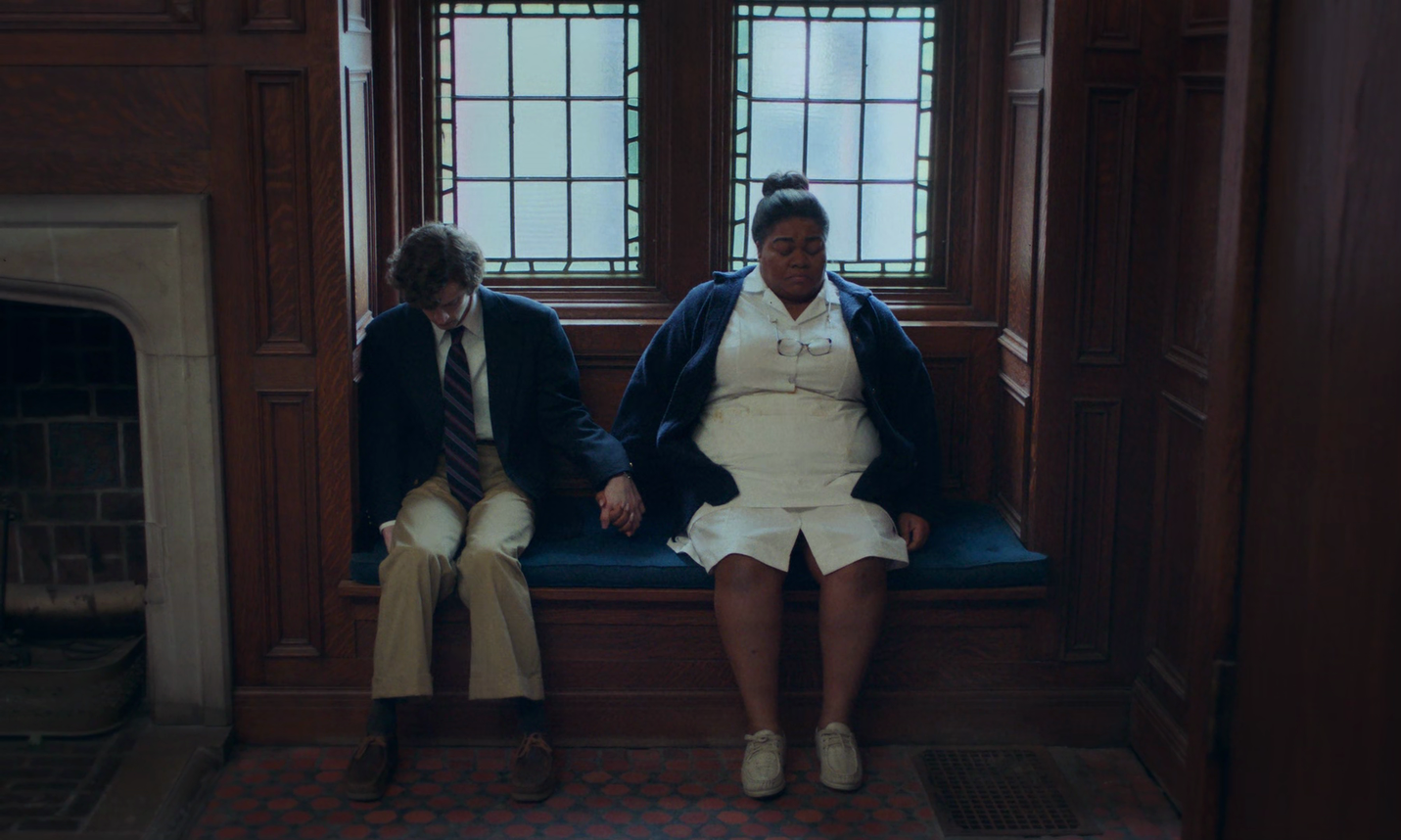
When Angus tells Mary he thinks he is going to be sent to military school, Mary’s wordless response is shaped by the loss of her son and expressed in the simple gesture of offering her hand for Angus to hold as he waits for the decision being made about his life without him. In this moment, Angus is no longer read simply as oppositional or privileged, but as a young person suspended between possible futures. Hunham, having come to recognise himself in Angus, chooses his student’s future over his own job security, a choice that becomes a form of liberation and suggests that change is possible through human connection.
Questions for analysis
| 1 | How does The Holdovers initially position Angus as a ‘typical’ Barton student, and when and how does it begin to complicate that first impression? |
| 2 | How does Angus use sarcasm as a defence mechanism, and what does this reveal about him? |
| 3 | Explain how film techniques in the classroom scene reflect the power struggle between Angus and Hunham |
| 4 | How does Angus’s treatment of other students (such as Kountze and Ye-Joon Park) challenge or reinforce viewers’ understanding of him as privileged or empathetic? How does this feed into the ensuing narrative? |
| 5 | How does Angus’s relationship with Hunham shape his development, and what does each character reveal about the other? How does Angus view his future and how does this affect his behaviour? |
Mary Lamb
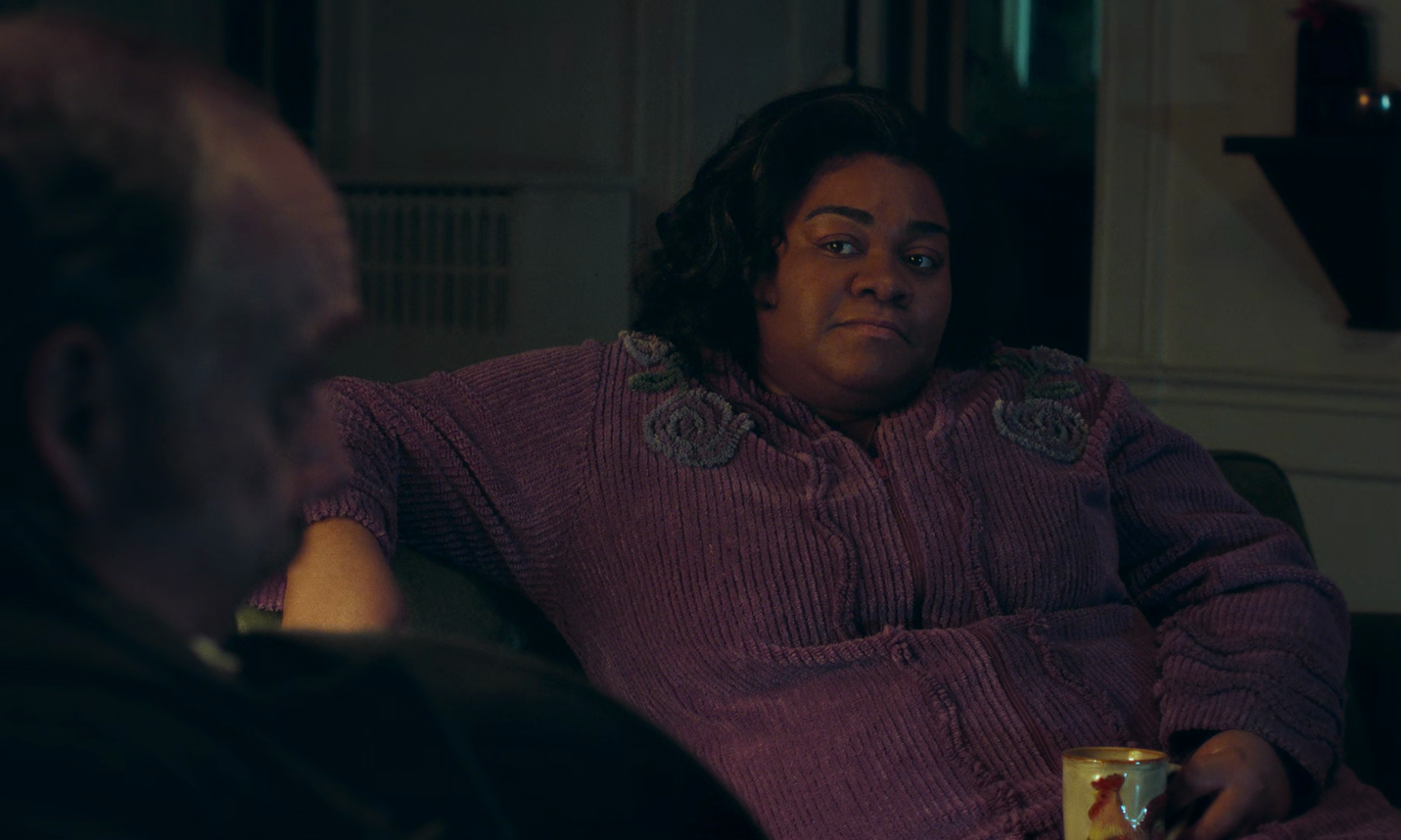
During the extended opening sequence, Mary is briefly introduced at work managing the cafeteria kitchen. As she mashes the potatoes, a close-up shows her pausing to look pensively through the window at the falling snow outside. In her next appearance, she is shown sitting in the front row of the chapel, as the death of her son Curtis is acknowledged during the final service before the Christmas break. Shot in close-up, Mary struggles to contain her grief in response to the condolences expressed by the school priest Father Joe. Each of these scenes takes place in spaces full of people, but Mary is alone and isolated in her pain.
Mary tells Hunham that she took the job at Barton to give Curtis a good education, and now that he is dead, she finds it hard to leave the place where she was last with him and could once look forward to his future. She also speaks to Hunham how she is not yet ready to spend Christmas with family.
Curtis's room has the air of being frozen in time – a memorial to his time at the school, as well as a symbol of Mary’s own life having come to a standstill as a result of his death. She is also acutely aware of the unfairness of the circumstances that led to Curtis’s death, and of how his fate contrasts with the experiences and expectations of the majority of students at Barton. She observes them living their privileged lives and thinks of her son “in the cold ground” with Barton boys "safe and warm in their beds" a statement that recollects the early close-up of her gazing through the window at the falling snow.
Perhaps because of their shared outsider status and sense of isolation, Mary and Hunham communicate honestly during their conversation while watching The Newlywed Game. In this scene she shares some of her feelings, and he in turn exhibits a surprising capacity to listen and connect. The scene's intimate framing and unhurried pacing communicates a rare moment of emotional openness between the two characters.
However, for the most part, Mary’s grief is something she keeps private. Unlike Angus and Hunham, whose grievances with life and the world affect their behaviour and treatment of others, she internalises her feelings and emotions. However, at Lydia’s Christmas Eve party, Mary becomes overwhelmed by her pain and by the reality of Curtis’s death. Faced with Mary’s heartbreak as she stands sobbing at Lydia’s kitchen sink, Hunham and Angus find themselves – for once – speechless.
Just as Mary gives Hunham the chance to reveal a better self in the conversations in the empty school, she also sees beyond Angus’s bravado. She is highly aware of the emotional significance of being left behind at Christmas and rebukes Hunham for making Angus feel unwanted. She is as forthright as she is empathetic:
Mary: “You don't tell a boy who's been left behind at Christmas that you're aching to cut him loose. That nobody wants him. What the fuck is wrong with you?”
Mary’s sensitivity to Angus’s loneliness and experience of rejection allows her to see beyond his privileged background and recognise his vulnerability. In turn, he responds to her with gratitude, thanking her for giving him his first “real family Christmas”.
Although Mary has struggled to imagine a future for herself after Curtis’s death, the trip to Boston becomes an opportunity to reconnect with her family and welcome the birth of her sister Peggy's child. Her decision to give away Curtis’s carefully preserved baby clothes symbolises a tentative willingness to move forward while still honouring his memory. In her final conversation with Hunham, she encourages him to embrace a future beyond Barton by travelling and writing. At the same time, she begins to redefine her own future, not as a mother looking back on what has been lost, but as an aunt looking forward to helping her sister’s child attend college.
Like Hunham and Angus, Mary occupies an outsider position within the world of Barton. Unlike them, however, she responds to her isolation with empathy rather than bitterness. Through her relationships with both characters, she functions as the emotional anchor of the film, prompting them to become more honest, compassionate, and hopeful versions of themselves.
Questions for analysis
| 1 | How is Mary introduced in the opening scenes of the film? What do these scenes reveal about her emotional state? |
| 2 | How does the film use visual techniques, such as close-ups and setting, to communicate Mary's isolation and experience of grief? |
| 3 | Why do you think Mary and Hunham are able to communicate so honestly with each other? |
| 4 | Compare Mary's approach to dealing with pain and loneliness with those of Hunham and Angus. |
| 5 | How does the portrayal of Mary's character communicate ideas about loss, hope, and human connection? |