The Holdovers - Themes & values
Found family
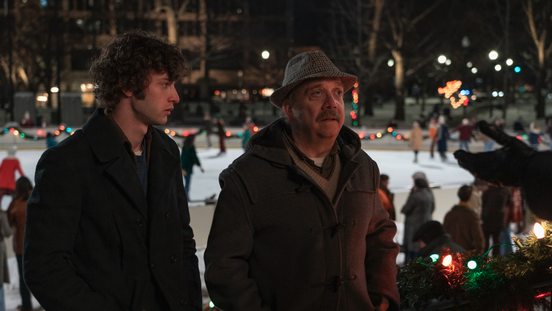
Through the three main characters Mary, Angus and Hunham, The Holdovers explores themes of family and connection. Finding themselves in each other’s company through circumstance rather than choice, the trio form a makeshift family bound together by isolation and loss.
Mary has opted to work over Christmas because it keeps her closer to Curtis: “This is the last place my baby and I were together, not counting the bus station.”
Hunham has been rather unfairly lumped with the task of supervising ‘holdover’ students. And Angus has not only been unexpectedly excluded from the family holiday by his mother and stepfather but is then left behind after the other remaining students are whisked away to the ski fields. It is made apparent that each feels a sense of grievance: Hunham is denied the break all the other teachers are getting, Angus feels rejected by his own family, and Mary is left to cater for and serve food for privileged ‘pricks’. None of them is in a positive state of mind, each bringing with them a personal history of loss.
Notably, it is the cantankerous and emotionally disconnected Hunham who visits Mary in the kitchen at the beginning of the holdover period, expressing a sense of solidarity at being left behind to look after the remaining students. The pair also bond over their shared appreciation of the softening effects of bourbon. Subsequently, Hunham seeks Mary out in the staff common room where she introduces him to The Newlywed Game and once again shares her bourbon. In Mary’s company Hunham is unexpectedly thoughtful and gentle, providing a glimpse of the better self that has become overlaid with bitterness and resentment. He clearly enjoys Mary’s company and appreciates the chance to suspend the performance that has become part of his life, while Mary’s understated candour encourages a more genuine form of exchange between them.
Once the other boys have departed and Angus is left behind, Mary plays a central role in the formation of the makeshift family. The scene in which a devastated Angus watches the helicopter fly away without him cuts to that evening, where a medium close-up isolates Angus against a dark background, visually reinforcing his disappointment and exclusion. He is now reluctantly sharing a common space with Mary and Hunham in the common room, where The Newlywed Game once again plays in the background. Mary and Hunham have already established a tentative friendship through their shared conversations and rituals, and Angus's exclusion from the ski trip creates the conditions for his own tentative entry into this emerging social unit. As Mary encourages Hunham to speak about his life, Angus can be seen in the background of the shot absorbed in his own disappointment. However, when Hunham reveals his unfulfilled ambition to travel to the ancient world and complete his monograph on Carthage, Angus begins to engage, questioning why Hunham only aspires to write a monograph rather than a book. Mary's response—"You can't even have a whole dream, can you?"—cuts through Hunham's self-defeating pessimism while also drawing Angus into a conversation characterised by honesty and vulnerability. This scene sets up the shape of the makeshift or surrogate family that will gradually form during the holiday break.
At the same time, the growing connection between Hunham and Angus is facilitated by their temporary removal from the routines and expectations of school life. This creates space for both characters to lower their emotional defences and move beyond the personas they have constructed to protect themselves. While each of them begins by relying on their established behaviours – Hunham authoritarian and Angus defiant – Angus’s dislocated shoulder and the subsequent trip to the hospital initiate a series of events that begin to shift their relationship beyond the conventional teacher-student dynamic. Although neither is immediately endeared to the other, this episode establishes a fragile rapport that begins to lower their emotional defences.
Mary's mediating presence helps shape the developing relationship between Hunham and Angus. Although overwhelmed by grief, she retains her capacity for empathy and remains attentive to the unhappiness of others. For instance, when Hunham tries to bow out of Lydia’s Christmas party, Mary is adamant that Angus be allowed to go. She also reacts strongly when Hunham expresses how little he wants Angus’s company over Christmas, a moment of anger that contributes to Hunham going out on Christmas morning to buy a Christmas tree. Hunham’s pride in the lopsided unornamented tree shows how much he has taken Mary’s words to heart.
The shared Christmas meal, which Angus in particular experiences as meaningful and affirming, establishes a growing sense of comfort and familiarity within the group, alongside an emerging dynamic of care and mutual recognition. This is reinforced by the extreme high-angle shot of the three characters seated at one end of a long dining table, surrounded by empty tables and chairs in the school dining hall. Rather than emphasising loneliness or alienation, the composition reframes the group as intimate and self-contained, suggesting the formation of a small but significant surrogate family unit.
Take a moment to think about the word surrogate, as it is a strong one when discussing family. Although the three form a surrogate family of sorts, it's notable that Hunham does not become a surrogate father to Angus. Similarly, Angus does not become a surrogate child to Mary.
The intimate Christmas scene leads into the group’s decision to travel to Boston, with Hunham working out a way to bypass school rules in contrast to his previous draconian behaviour. The Boston trip is a turning point in the narrative. Mary takes a step back into life by visiting her pregnant sister, and begins to make plans for the baby’s future. Hunham and Angus move beyond the teacher student relationship to connect more authentically after they learn about each other’s personal histories. Hunham’s encounter with a former Harvard acquaintance reveals the lost opportunities that underpin his rigidity, while Angus’s visit to his father exposes the emotional vulnerability behind his antagonistic behaviour. When the trio reunite, they symbolically mark the end of the trip by preparing an improvised cherries jubilee on the car boot, which they then set alight in a shared moment of spontaneity.
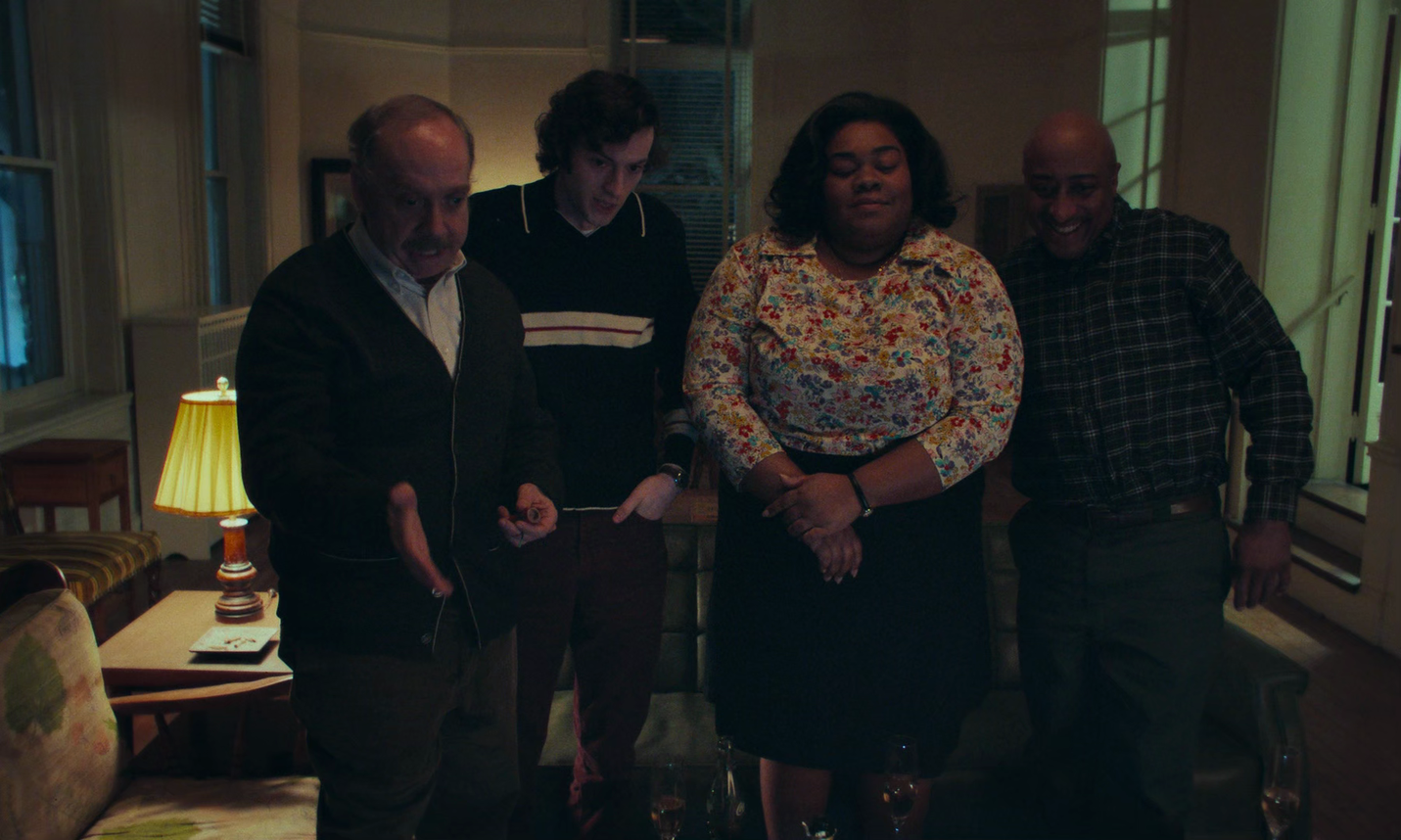
Within film narratives, makeshift families are typically formed under temporary circumstances, even if their emotional significance extends beyond them. In The Holdovers, the transition from the New Year’s Eve celebration is abrupt. Danny joins the trio, and their marking of the new year is warm and affectionate. Hunham lighting a forbidden firecracker in the kitchen captures a final moment of shared release before the screen fades to black. The following shot returns to Barton Academy, where the grounds are once again filled with anonymous students moving in regimented patterns as they run laps, complete drills, and use rowing machines in unison.
However, the ending is not a simple return to the status quo. Hunham’s decision to sacrifice his position in order to protect Angus suggests that the connections formed during the break continue to shape his actions beyond the school setting. Similarly, Mary’s farewell to Hunham and her investment in his future indicate an ongoing connection even as the group disperses. The surrogate family is not sustained as a permanent unit, but it persists in the choices the characters make after the holiday ends.
Questions for analysis
| 1 | How does the shared sense of loss help Mary, Angus and Hunham form a surrogate family? |
| 2 | What role does Mary play in strengthening the relationship between Hunham and Angus? |
| 3 | How does the Boston trip change the connections between the three characters? |
| 4 | Why is Hunham’s decision to protect Angus significant to the film’s message about found family and connection? |
Change & moving on
Change in The Holdovers is presented not as dramatic transformation or emotional resolution, but as the difficult process of moving beyond the patterns that keep people stuck. Hunham, Mary and Angus have been shaped by past disappointments, grief and uncertainty. Rather than actively moving forward, they have learned to endure, relying on routines and behaviours that protect them from confronting painful realities.
The narrative suggests that such forms of self-protection can become their own kind of trap. Hunham retreats into cynicism, intellectual superiority and alcohol; Mary contains her grief behind composure and care for others; Angus masks his vulnerability through rebellion and disruption. Set during Christmas, a season traditionally associated with family, renewal and hope, their isolation at Barton Academy highlights how disconnected they have become from these possibilities.
Rather than offering easy solutions, the film presents change as a gradual shift in perspective. This is most evident in its rejection of determinism. Angus fears that his future has already been shaped by his family circumstances, particularly his father's mental illness. However, Hunham ultimately challenges this belief, insisting that a person's history does not have to dictate their destiny. The narrative therefore presents growth as the willingness to imagine a future that is not predetermined by the past.
The conclusion reinforces this idea. None of the characters achieves complete closure, yet each begins to imagine a future not entirely governed by loss or disappointment. Hunham's departure from Barton is especially significant. Although it appears to be a professional setback, it also represents a break from the routines and resentments that have defined his life. Significantly, the film ends not with arrival or resolution, but with a shot of Hunham’s car travelling down an open road, accompanied by Labi Siffre’s “Crying, Laughing, Loving, Lying”. The lyric “Crying never did nobody no good no how” reframes emotional pain as something that cannot define or immobilise the future. In this way, sound and image work together to reinforce the film’s understanding of change as movement rather than resolution, and as an openness to uncertainty rather than closure.
Questions for analysis
| 5 | What behaviours do Hunham, Mary, and Angus use to protect themselves from pain, and how do these behaviours prevent change? |
| 6 | How does the film challenge the idea that a person's past determines their future? |
| 7 | What does the ending suggest about the nature of change and personal growth in The Holdovers? |
| 8 | The title of the film refers to students 'held over' the Christmas break, but how could you also apply the term to Angus, Hunham and Mary, and the state of their emotional lives at the beginning of the film? |
Future possibilities
The Holdovers repeatedly returns to questions of the future, particularly how it is unevenly distributed, disrupted, or reimagined across different social and personal circumstances. Education is inherently oriented towards the future, with schools and teachers positioned as active participants in developing students’ potential and preparing them for lives beyond the classroom. The setting of the elite Barton Academy foregrounds this emphasis, as students and parents alike understand their place there as an investment in future success and social mobility.
Within this context, Hunham initially appears to have lost sight of his role in enabling students to realise their potential. His own sense of thwarted academic ambition fuels a bitterness towards the entitlement and certainty with which Barton students approach their futures. When he returns their exam papers, he takes apparent satisfaction in their poor results and actively disrupts Kountze’s ambitions. However, through his developing relationships with Angus and Mary, Hunham is encouraged to look forward rather than back. He ultimately chooses to invest in Angus’s future, breaking from the predictable trajectory that would otherwise see him remain indefinitely at Barton. Hunham has sacrificed one version of his future, but in doing so, has opened up new avenues of possibility for himself.
As Hunham prepares to leave, Mary offers him a gift of an empty journal, inviting him to pursue his unrealised ambition to write and to imagine a future no longer confined to Barton or its routines. In parallel, she also reorients herself towards the future in a different form, establishing a college fund for her niece or nephew following the loss of her son Curtis, whose future was foreclosed by a convergence of structural disadvantage, including race, class, and circumstance. Both Hunham and Mary frame the future as something that can be reimagined even in the aftermath of loss.
Questions for analysis
| 9 | In what ways do Mary, Hunham and Angus learn to reimagine their futures despite the losses they have experienced? |
| 10 | How does The Holdovers show that opportunities for the future are shaped by factors such as class, race, and personal circumstance? |