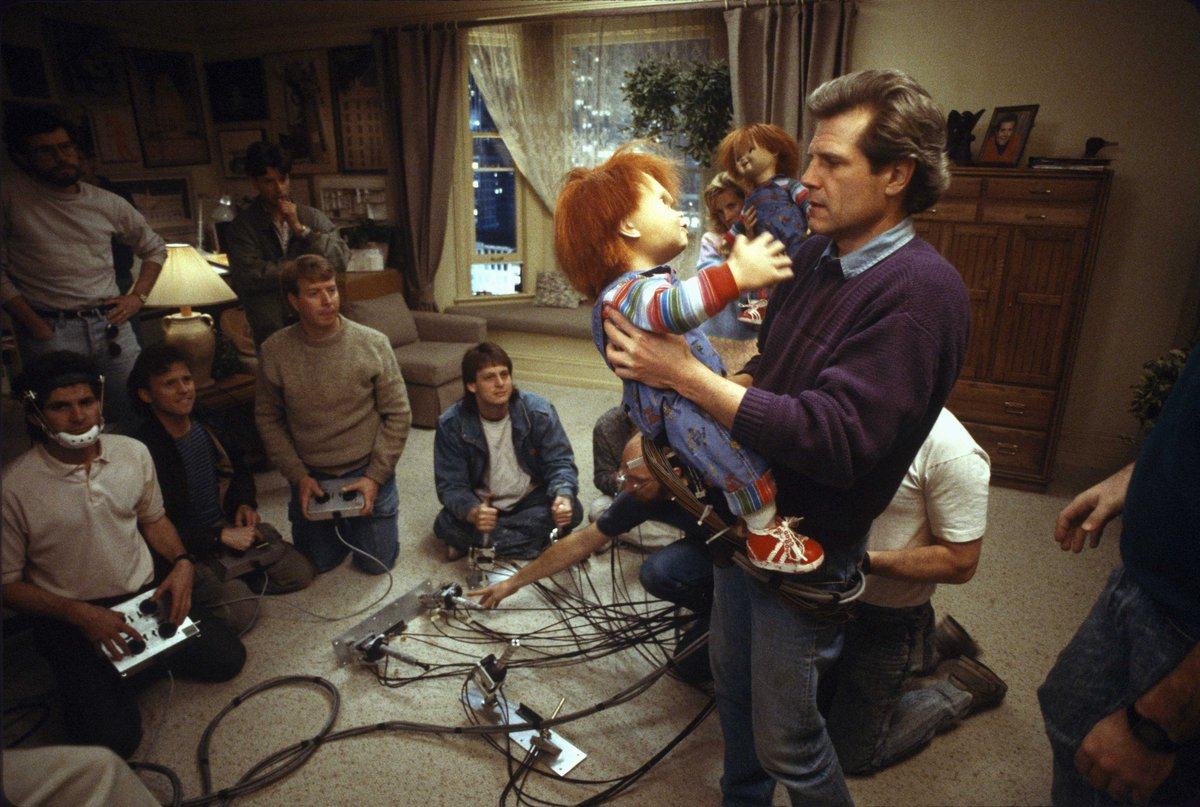

Since the first Child's Play film in 1988, Chucky has been built, burned, broken and brought back to life across seven films and three seasons of television. His presence has unsettled us, made us jolt in our seats and cover our eyes. And as the franchise expanded into horror-comedy while embracing queer characters, Chucky has also made us laugh while complicating our expectations of the slasher villain on screen.
But what does it take to make us believe in the diabolical terror of this murderous doll?
"It's a team sport and it's a very elaborate process," says writer/director Don Mancini, "but something that we've gotten down to a pretty well-oiled machine by this time."
ORIGINS OF A GOOD GUY
Chucky has been brought to life on screen for over 35 years and this started with Mancini, who wrote the first Child's Play film while he was in film school at UCLA in the 1980s.
Mancini’s awareness of "a presence behind the camera" began with the popular disaster movies from his childhood, including The Poseidon Adventure (1972) and The Towering Inferno (1974).
“I was just really taken with those movies and just the make-believe that went into convincing the viewer that we're on an overturned ocean liner or at the top of the tallest building in the world, which is on fire!"
Their “extremely spectacular deaths” also ignited his lifelong interest in the horror genre, so when Mancini started writing Child's Play he was already aware of the killer-doll trope.
This trope has had a long life both on screen and off, tapping into our fears of corrupted childhood innocence, as well as the unease we experience towards lifelike but inanimate objects. Since the early twentieth century, this concept has been described as "the uncanny" in Freudian psychology, whereby the familiar becomes strange. A similar term "the uncanny valley" was coined by roboticist Masahiro Mori in the 1970s, to describe the experience of when a robot or puppet appears too lifelike or human, and we are no longer endeared, but unsettled.
Dolls have brought these fears to life on screen as early as The Great Gabbo (1929). Mancini was particularly taken with the gradual menace of Talky Tina in the ‘Living Doll’ episode of The Twilight Zone (1963), as well as the foul-mouthed ventriloquist dummy named Fats from the horror film Magic (1978) starring Anthony Hopkins. "I realized" Mancini recalled, "it had never been done in such a way where the doll was treated as a full-fledged character."
The first impetus for the Child’s Play script, however, came from Mancini’s desire to write a dark satire about marketing and advertising towards children. The malevolence of this industry was familiar to Mancini from an early age, as his dad worked in marketing and advertising.
"I was so struck as a child to learn that children like myself at the time were referred to as consumer trainees."
Mancini looked to the intense popularity of Cabbage Patch Kids happening at the time, recalling massive lines outside toy stores that stretched over blocks, and news reports that documented riots at a few stores when stock ran out. These mass-marketed dolls were a blueprint for the Good Guy doll that informed Mancini’s detailed description of our friend to the end in his initial script:
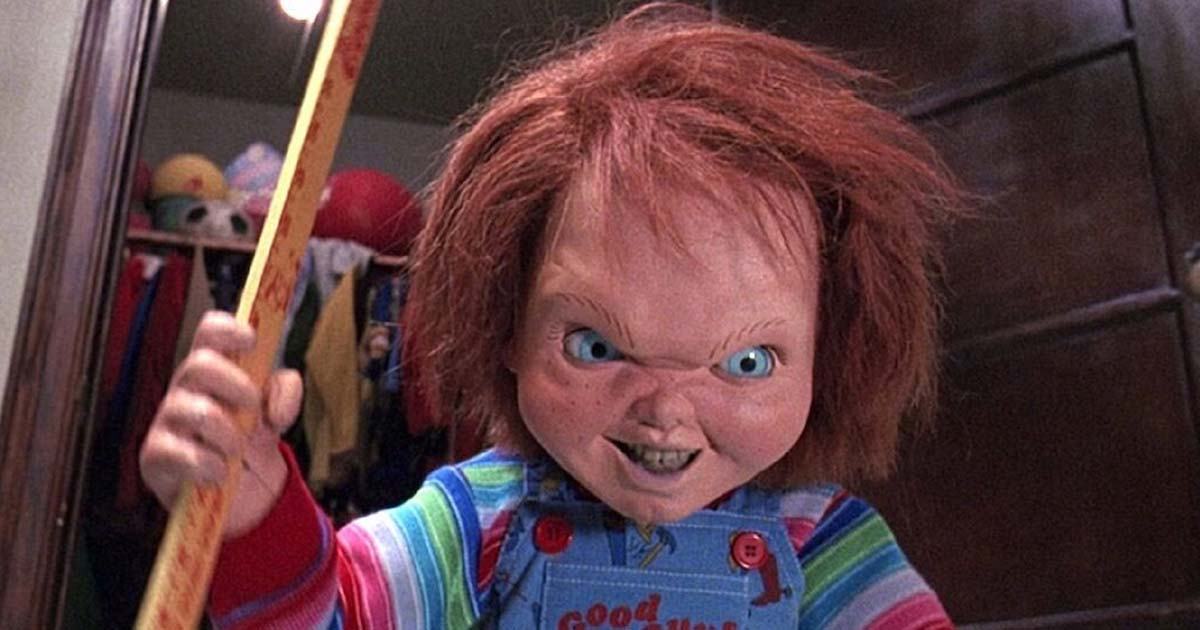
"I thought his look should have a certain generic quality to it because that's part of his disguise. He seems utterly unthreatening. And so, it needed to seem familiar. But I think specific details like the red hair are important because in fairy tales red hair means evil. So, it's just definitely a signal of maybe of what's to come. I always knew that the blue eyes would be chilling, just like these blue marble eyes. But suddenly, when we add little bits of red in it, little bits… almost like touches of humanity or life."
Voice Activated
As with his initial script, the process for bringing Chucky on screen "always starts with the writing". Across the franchise, Chucky's unthreatening familiarity has continually seen him enter and kill in domestic spaces. From the Barclay's apartment in Chicago, Jennifer Tilly's Bevery Hills mansion, to the White House, Chucky has continued to corrupt the safety and security of his victims' homes. These stories cross genres and decades, from psychological and slasher horror in the late 1980s, through to campy horror comedy in the 2000s. These tonal shifts across the franchise are carried by Chucky's dark humorous dialogue. "Chucky is a fun vessel to broadcast this sort of dark, satirical look at different aspects of culture," Mancini says.
To bring Chucky from the page onto the screen, Mancini says two key elements that are "completely indispensable" to the process: the voice acting of Brad Dourif and the puppetry work by Tony Gardner and his team at Alterian Inc.
Dourif has been part of the Chucky franchise since he appeared in the flesh as the Lake Shore Strangler Charles Lee Ray in the first film. Fatally shot and on the run from police, Ray hides in a Chicago toy store where he transfers his soul into an unassuming Good Guy doll. From then, Dourif has voiced the character in all sequels and the TV series – but not the 2019 reboot.
"He is one of the most talented actors of his generation," Mancini says about Dourif, "he's so linked to the character of Chucky, it is impossible to imagine it without him." This praise of Dourif is not overstated. Dourif seamlessly transforms into characters and becomes unrecognisable in some of the most well-known films: from his Oscar-nominated performance in One for the Cuckoo's Nest (1975), to portraying Gríma Wormtongue in The Lord of the Rings: The Two Towers (2002).
Initial recording sessions happen with Dourif following the writing, which is a crucial stage in how Chucky comes to life on screen. For Mancini, this is a two-way exchange. "He always has something to say about Chucky and some things I write about he'll sometimes ask me to rewrite. But it's gotten to the point where a lot of what I do is try to think of new ways to challenge Brad and keep it interesting for him and keep it fun."
Dourif's vocal performance was one of the main motivations for Special Makeup Effects Artist and Puppeteer Tony Gardner to join the Chucky Franchise. “Brad Dourif put so much personality into the voice." Gardner recalls "I thought it would be really fun and really challenging to see how much personality we could put into the performance of something that was so animatronic on Seed [of Chucky].”
Building a nightmare
Seed of Chucky (2004) was the first Chucky film that Gardner worked on as the Head of Special Effects Department in the Chucky Franchise. The original design and animatronics had been led by Kevin Yagher, at a time where animatronics on screen were still in their infancy. Mancini had the early sophisticated animatronic work on Gremlins (1984) in mind when thinking about how the “full-fledged character” in his script could be realised practically on screen. "There's such a nuance of emotion now possible in these little plastic robot creatures," Mancini recalled. "You could write pages of dialogue for the doll and they could actually enunciate it synchronously."
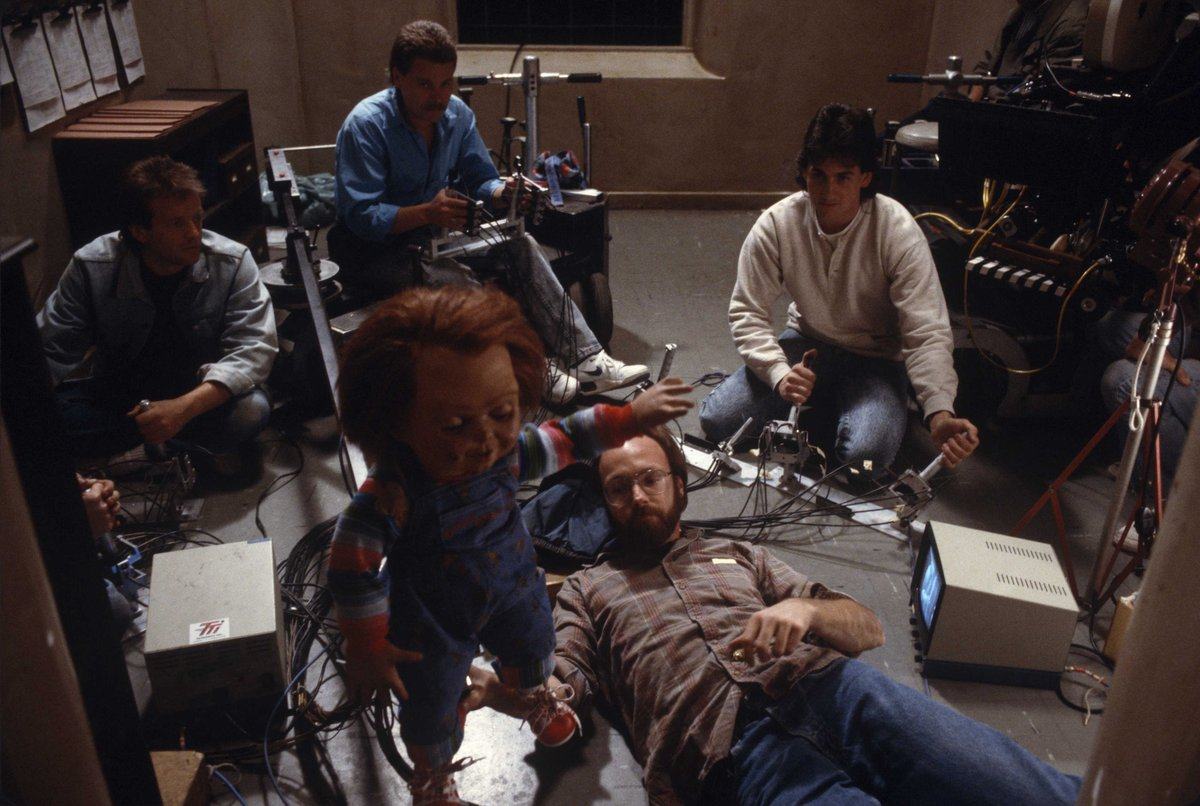
Yagher created the cable-controlled dolls featured in the first four Chucky films, which could require up to 11 puppeteers to perform. When Gardner started working on Seed of Chucky, he had to accurately photo match the appearance and function of Yaghner’s animatronic Chucky and Tiffany (voiced by Jennifer Tilly) dolls from the previous film Bride of Chucky (1998). "This was the days before the internet," Gardner explained, "so we had literally a VHS copy of the movie and were freeze-framing it on the TV, and taking photos and developing photos, to give us the reference we needed because Universal didn't have anything for us."
Recreating the look of existing characters was not new to Gardner. His passion for the art of special effects and make-up effects began in his youth, recreating iconic monsters from the films of his childhood, including the facehugger from Alien (1979): "I was just hypnotised by how creative it was and how real everything seemed."
Lots of little details were involved for Gardner's team in recreating the look of these two existing characters, which was one of the practical challenges that interested him in the project. From the facial details such as their eyes, hair and teeth, to the exact details of their clothes like the knit of the fabrics, the style of Tiffany's mini leather jacket, as well as high-heeled shoes. "We were sculpting and molding shoes and doing things we'd never done before in order to get these things created."
"I have a queer kid."
Mancini first included explicitly queer characters in Bride of Chucky. However Seed of Chucky introduced Glen/Glenda (voiced by Billy Boyd), Chucky's gender-fluid child and the first trans puppet character in a mainstream horror film. Glen/Glenda only had a fleeting appearance as an infant in Bride of Chucky, so Mancini worked with Gardner on the character design as not only the writer, but as a first-time director.
"The only reference we had was pointy teeth and a pointy face and big blue eyes. Don Mancini wanted to lean into those features" Gardner recalls. "But there's so many different ways you could have a pointy chin and pointy teeth." The process from there involved designing and sculpting six or seven heads for Mancini to choose from and figure out a direction.
"I find [Glen/Glenda] hilarious and heart-rending honestly." Mancini says. When deciding to centre the plot on Chucky’s child, Mancini wanted to do the least expected thing. "The idea of them being this sweet pacifist and just how that would work as a metaphor for a gay kid ... that was a fun way of looking at that through a kind of amusing prism."
Doll logic further informed Glen/Glenda's gender identity: "I grew up with four sisters and they had dolls and sometimes they had no anatomy. So I thought, well, that's interesting right there. And because of my own situation, as a gay kid in my conflict with my father, I realised, oh… they're non-binary. And because lots of dolls are, that makes sense that they would be."
While Seed of Chucky’s embrace of meta-comedy and satire instead of traditional horror was not widely appreciated on initial release, Glen/Glenda’s pioneering story arc of queer familial acceptance and the film’s campy tone has made it a queer cult classic.
Since then, Mancini has continued to make the franchise "gayer and gayer", including a cast of queer characters in the two films that followed – Curse of Chucky (2013) and Cult of Chucky (2017) – and the Chucky television series (2021-2024) that Mancini worked as the showrunner on. "While [Chucky] is an avatar for Halloween and for the horror genre,” Mancini explains, “he's also an avatar for queer acceptance." A recent notable example of this is Chucky's conversation with protagonist Jake in the second episode of the television series:
CHUCKY
You know, I have a queer kid.
JAKE
You have a kid?
CHUCKY
Gender-fluid.
JAKE
And you're cool with it?
CHUCKY
I'm not a monster, Jake.
"I think that that's a fairly new and kind of cool thing for a horror." Mancini says.
Made in Japan: from animatronics to banraku puppetry
Replicating the previous cable-operated approach on Seed of Chucky involved extensive work to build raised sets, which concealed all the cables that Gardner's team puppeteered from underneath with pulleys and controllers. Gardner saw the opportunity for a more seamless and genuine performance by leaning further into rod puppetry.
"The whole approach was to turn him into a bunraku puppet," Gardner explains.
The cable-controlled head, arms, legs were replaced over time with one rod to puppeteer head movements, two rods for the arms, and two for the legs. This replicates bunraku: a style of rod puppetry that originated from traditional Japanese puppet theatre.
Animatronics – radio-controlled hands and face – continue to be used for Chucky, allowing separate puppeteers to each control specific features, such as the eyeballs and the eyelids, the eyebrows and the mouth. Up to nine puppeteers are needed to perform Chucky, which Gardner describes as “a lot of people that have to think as one person.”
“And it's all movement that if we get it wrong,” Gardner notes, “it'll be very obvious that we get it wrong because they're very straightforward human movements.”
Gardner looks to Brad Dourif to ground Chucky’s performance. Starting with the audio of Dourif's vocal performance, Gardner’s team practice the lip sync and pre-records the mouth shapes and jaw movement.
"Don still had the flexibility to change a line and we could do it live. Or if Brad wanted to change something or delete it, we could alter it. But it gave us a base foundation going out on set where we knew the mouth was true to Brad's delivery. And then we could focus the whole rest of the character's performance."
Taking video footage of Dourif while he records his dialogue is also crucial: “we can see how he's using his hands and how he's using his face and try and recreate that with the puppet.”
By adopting bunraku puppetry, the puppeteers are crouched behind the two-and-a-half-foot-tall Chucky to perform his lifelike movements. To conceal the rods and puppeteers from the shot, Gardner and his team are supported by a visual effects crew for digital removals: “thanks to visual effects, we can put a rod out of the top of his head and puppeteer left, right, up and down by moving that rod and just pull the puppeteer out.”
You can't keep a good guy down
Sophisticated visual effects support practical ones in the Chucky franchise. While the Chucky films have spanned a significant period of CGI and visual effects history, Mancini and his team have intentionally resisted realising Chucky as a CG character. “I hope we'll continue to always resist that,” Mancini says, “because having him there is so invaluable to the other actors that they have this thing who's performing with him and expressing his side of the scene.”
Performing and directing Chucky on set, however, requires a significant level of coordination and planning. As expected, Chucky tends to get the most takes.
Working with the same group of puppeteers across the entire Chucky TV series, Gardner recalls, was crucial in finding a rhythm and routine. This not only enabled the efficiency of shooting, but made the difference in the effectiveness of the character. “We would always rehearse, and we would shoot what we were doing on video. And we always asked for storyboards of Chucky's scenes, so we knew what angles they wanted to shoot from, so we knew which rigs we were going to use for each shot.”
Mancini relies on camera angles and sound to subtly heighten the emotion of the puppeteer’s performance. This includes shooting at low camera angles that play into “the uncanny valley” that Chucky occupies, emphasising the creepiness and making him feel more threatening. Sound is another subtle but important factor. “The sound guys use little squeaky Rubik's cubes sometimes,” Mancini recalls, “we work really hard on that, just to get the right sound of squeaking for his feet when he's walking, because it needs to sound lighter than a person.”
Drawing on the human and inhuman sides of Chucky was a direction that Mancini leaned into based on how scary a scene was meant to be. “Don would direct us,” Gardner says, “and he would say, ‘I want it to be more herky-jerky and doll-like and less human because I feel it's more unsettling for this particular scene.’ And then there's other scenes where everything would need to be fluid because it's the dynamic of the scene is a family argument. And it's got to be really quick and very much alive.”
Archetypal expressions and gestures similarly achieve emotional beats, which can even be as simple as Mancini gesturing to a puppeteer to drop Chucky’s brows to immediately communicate anger. For Gardner, these smallest gestures and interactions are the things that make Chucky feel alive, such as stroking the chin or scratching his shoulder while he is talking. “We were always trying to add some little character thing like that. Even just with the eyes squinting at the angle of the head to try and give him more personality or more anger.”
Chucky’s human co-stars play an equally crucial role. From seemingly innocuous details like getting Chucky’s eyeline right, Mancini adds, “They have to make us believe that he is alive. And that is tougher than it sounds, honestly.”
Friends to the end
Chucky’s last appearance on our screens was in 2024, during the final season of the Chucky television series. For Mancini, the series was an opportunity to lean into the versatility of the character. “We could range all over our preferred genres,” Mancini explains, “even in the course of just a single episode.”
Chucky is destined to return to us on the big screen, and Mancini’s intention is to make it “full-bore scary again.”
Since 1988, Chucky’s habit of coming back to life and killing in exceedingly diabolical ways has become a legacy that makes even his stillness terrifying.
Some of the most effective scenes, according to Mancini, use “the ticking bomb” that Chucky represents as a static doll. “It’s just the implication of his presence and what that implies that can be really psychologically interesting.”