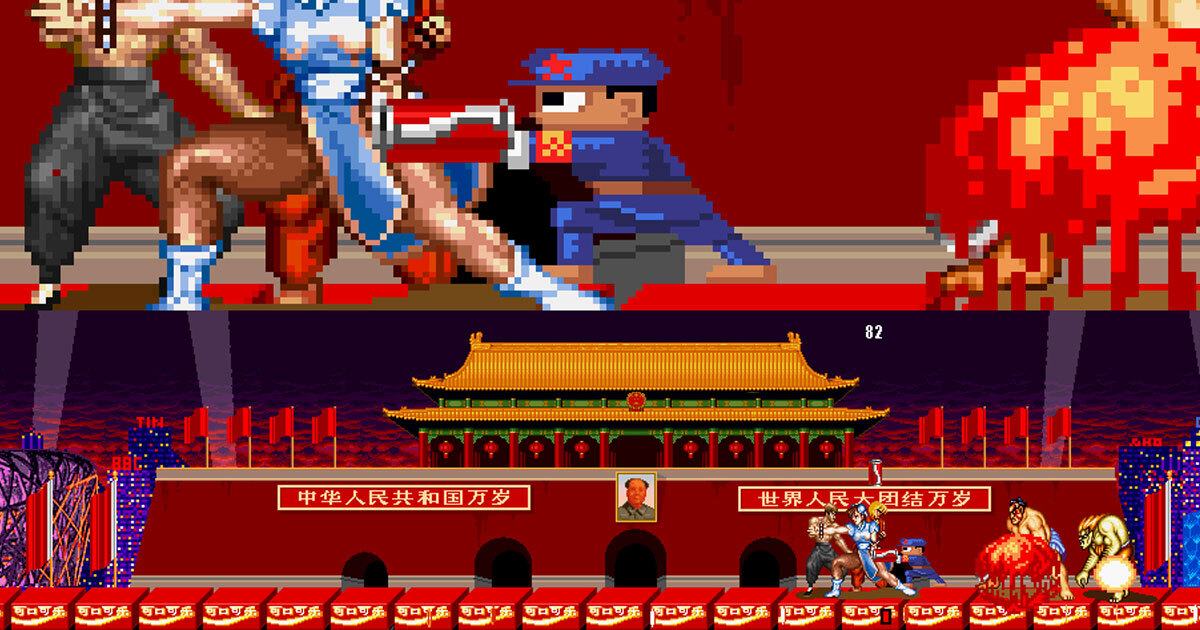

Long March: Restart is an interactive adventure inspired by the Long March, the Chinese Red Army’s military retreat of 1934–36. It unfolds as a side-scrolling videogame artwork across two giant screens. A Red Army soldier travels through an 8-bit world inspired by historical landmarks and retro games like Street Fighter II and Super Mario Bros. Armed with exploding Coca-Cola cans, he fights iconic characters, aliens and armies as revolutionary history and global pop culture collide.
Michaela Bear: Videogames have been an interest since your teenage years. What first drew you to them?
Feng Mengbo: Around 1985, I got my first Nintendo 8‑bit compatible home console, along with a cartridge of Super Mario Bros. and a light gun Duck Hunt game. Their narrative, visuals, music and interactive design perfectly matched all my ideals about games and art. Most kids would lose interest after finishing the game, but I could play these simple games over and over again, as if I were appreciating a perfect artwork. I even fantasised that one day I might create videogames myself.
MB: What was the catalyst to finally bring this passion into your creative practice?
FM: A strong sense of curiosity has always driven my learning and creative work. From art to technology, I’ve always wanted to understand the secrets behind things, and I believe that if something is created by humans, then I should be able to do it too. When you always have something you want to learn and achieve, any setback or failure simply becomes part of the necessary path.
MB: Can you share what inspired you to create Long March: Restart? It would be great to hear how the work evolved from your initial idea for the project in 1994 to its realisation in 2008.
FM: The Long March of the Chinese Workers’ and Peasants’ Red Army in the 1930s lasted multiple years and covered 12,500 km, overcoming countless hardships and battles along the way. I felt this epic story was perfectly suited for a 2D side-scrolling game. In 1994, my personal computer and software were not advanced enough for me to create an independent videogame, so I produced a set of 42 paintings as if they were storyboards for a future game, and also made a sound‑based slideshow using software.
Later, I created many works using 3D game engines, interactive software, and internet technologies, but I never forgot the Long March story. In 2007, the release of the programming tool Multimedia Fusion 2 finally made it possible for an individual to create a 2D videogame. So I pulled in my friend Lu Yue and after more than a year of hard work, we completed Long March: Restart. It was an arduous process: 14 levels, numerous scenes, characters and music. Exhibiting it with a wireless controller and several projectors at such a large scale is still not easy even today – but we did it.
MB: Speaking of technology changing over time, you were born in 1966, the year of the fire horse in the Chinese zodiac and the beginning of the Cultural Revolution in China. Your installation opened at ACMI in 2026, 60 years later during the first fire horse year since 1966 – a ‘restart’ of sorts. In the spirit of the fire horse, representing rapid transformation, can you talk more about the significance of the term ‘Restart’ in the title of this work and how it explores a reflective shift in time and thinking?
FM: This is actually the first time I’ve heard the term ‘fire horse year’ (laughs). My generation has lived through earth‑shaking transformations, constantly swept forward by the tides of history without a chance to catch our breath. The ‘Restart’ in 2008 referred back to 1994. Today, mentioning ‘restart’ feels almost like a luxury – most devices don’t even have that button anymore.
MB: Yes, a ‘restart’ isn’t always possible, in games and life. We are fortunate to have such a button for the iteration on display at ACMI, allowing visitors to see the opening sequence of the work before they begin game play. Can you share more about the significance of this initial imagery?
FM: The opening animation draws from Chairman Mao’s handwritten poem ‘The Long March’ (1935) and the well‑known film The Long March Suite (1976), optimised specifically for an ultra‑wide screen. The powerful combination of visuals and sound creates a strong atmosphere that establishes a profound historical tone for the entire work.
MB: Are there ideas or other aspects of the project that continue to ‘restart’ or reappear in your creative practice? By contrast, how has your practice evolved since making this work?
FM: I’ve always been interested in the potential of videogames within artistic creation. The success of Long March: Restart encouraged me to continue making videogame‑based installations such as It’s Not Too Late (2010) and Mortal Kombat (2011). I don’t like standing still, so I’m constantly learning and working with new media, including virtual reality and artificial intelligence. In a sense, I’m continually restarting and renewing myself.
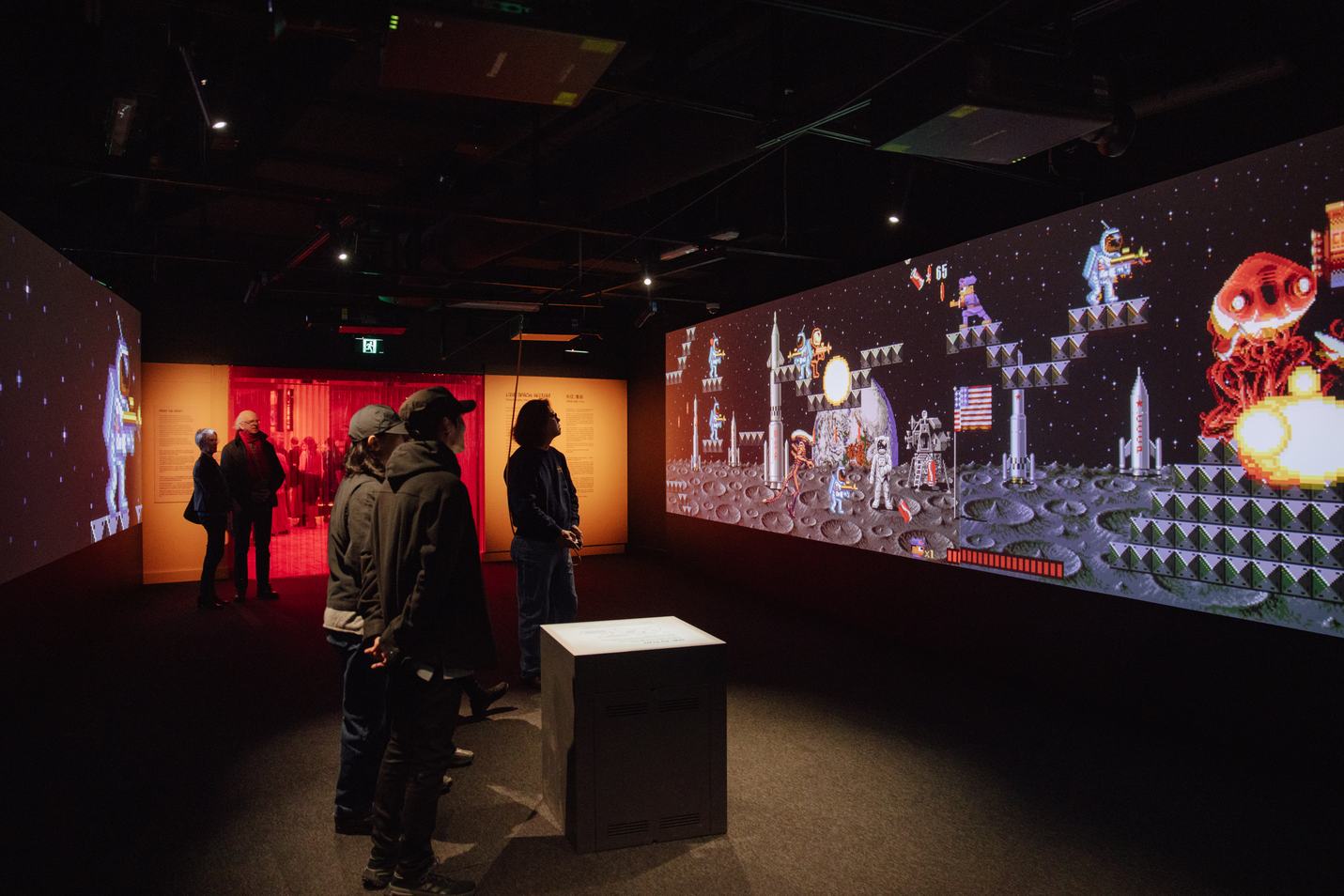
I’m very interested in the relationship between the virtual world and the physical world. Long March: Restart could easily be imagined as a typical single‑player home computer game, perhaps connected to a projector. I insisted on expanding the installation so that it felt like a child stepping into the world of a videogame. Later, when I worked with lenticular materials, Holovision (extended reality), and virtual reality, I faced countless challenges, but these immersive experiences are worlds apart from simple software displayed on a screen. Spatiality and the sense of presence have become increasingly important to me.
MB: The experiential possibilities of new technologies are evidentially central to your practice – offering rich opportunities for experimentation. With this in mind, what was the most interesting or surprising thing you learnt from creating Long March: Restart that has stayed with you?
FM: The most striking moment was seeing the installation on site for the first time, projected across eight massive screens – it was overwhelming. After more than a year of creating everything on a desktop monitor, I had grown used to that scale. Enlarged to this magnitude, it felt like an entirely new work; even the animation seemed several times faster. The biggest lesson I took from this project is that with a clear concept and persistent effort, independent creation can reach astonishing scales, even surpassing what a team might achieve. The audience reactions were also fascinating – especially children, who would start out amazed and then become completely absorbed in the game, forgetting they were in a museum. That was exactly what I hoped to achieve.