

A Sim slams a fridge door, mutters something unintelligible, and throws their hands in the air. Across the street, another Sim flirts outrageously with a playful wink and a bright "Sul Sul!". No subtitles required; every player knows what these moments mean.
For a game built on "nonsense" speech, The Sims speaks straight to the heart. Its characters cry, fight, flirt, and form relationships that players become deeply invested in. But how does it pull this off, without a single line of traditional dialogue?
The answer lies in a careful layering of performance. Animation, voice acting, sound design and the player’s own imagination all combine to create emotional clarity. It’s this textured performance that makes The Sims feel so alive.
Shrugs, side-eyes and stylised realism
When The Sims first came to life, it faced a curious design problem: how to make its characters talk without putting words in their mouths.
"If you go back and listen to the original Simlish, it kind of has a baby talk quality to it," explains audio director Robi Kauker. "Very simple, pretty short phrases. It was really an artifact of how we edited the performances, and the type of animating that was happening then."
Over time, the language became more nuanced. "We got more sophisticated words. That was kind of where Sims 2 started," he explains. "Then longer phrases, more ‘language’ qualities with things like repeated words."
But there was never really an intention of creating a ‘language’.
"We as the game developers don’t really tell the stories," Kauker continues. "We just give them a platform... Simlish, being largely without meaning, allows the player to decide what the narrative is."
“Universality is the most important function of Simlish,” agrees voice director Jackie Perez Gratz. “Like Robi said, having nonsensical words gives the actors complete freedom to maximise humour and emotion within their performances. The universality of the language gives players the freedom to make their own stories.”
But for anyone who’s played The Sims would know, it’s not just the voice work that carries emotion. Much of The Sims’ storytelling comes from its physicality, from an animated side-eye to a perfectly timed shrug.
Animation director Yusun Chung describes the aesthetic approach as "stylised realism", a blend of grounded human movement with just enough exaggeration to read clearly and universally. "Our team thinks of ourselves as actors behind the camera," she says. "We bring life to computer-generated 3D characters by applying believable and relatable expressions through gestures, body poses, and facial expressions. We ensure that the emotion is conveyed clearly before any sound is added."
“This approach captures the essence of universal human experiences – such as wants, fears, aspirations, and goals – to effectively communicate complex emotions,” she continues. “By focusing on common human nature, our animations are gender and body-type agnostic.”
Interestingly, this process is the opposite of how it’s usually done in film and TV animation. In The Sims, the performance starts visually. The animations are crafted first, and voice is added later. This reversal of the usual film pipeline requires the actors to match the animation’s emotional beats without relying on dialogue for context.
While Chung mentions pantomime as foundational to the game’s visual style, lead animator Chris Ondyak and animator Kathryn Peterson also bring their own techniques to the acting and animation process.
Ondyak physically performs scenes, sometimes filming himself to refine the physicality of the performance. He also draws inspiration from other art forms. “I worked on the Werewolves pack, and I listened to gothic, orchestral soundtracks for inspiration,” he says. “There's tremendous value in experimenting with acting to a soundtrack – the swelling of violins can influence the sweep of a gesture just as much as watching another actor perform.”
Peterson’s animations are informed by everyday life and pop culture. "I love saving little bits of audio or video that stand out to me," she says. "And I love people watching. There are so many people I’ve thought, ‘they’d make an incredible Sims NPC.’"
According to Chung, once animations are approved, multiple voice actors record various dialogue options for the same clip. Technology is then used to synchronise the Sims’ mouth movements with voice pitch in real-time, allowing diverse dialogue to work for different characters and contexts.
“Animators focus on universal human experiences, while voice actors infuse specific qualities into each dialogue, bringing their unique insights,” Chung explains.
Oofs, ahs and Sul Suls
When actors do get into the recording booth, the performance starts by stripping language away entirely. "It’s important to direct the actors to perform ‘non-verbal’ against the animations – just grunts and sighs and ahs and ohs," Perez Gratz says. “No Simlish allowed.”
“This gives the actors time to familiarise themselves with the timing of the animation and put emotion on each beat in its most basic form – a gasp for surprise, an oof for pain, an elongated sad sigh when a Sim doesn’t get their way, etc.”
When the language does come in, around 90% of it is improvised. The remaining 10% comes from a carefully curated Lexicon: words like "Sul Sul" (hello), "Neeb" (no), or "Lurv" (love, heart or matters of the heart), which anchor key emotional moments across the series.
According to Perez Gratz, some of the biggest considerations are given to coaching the subtleties of emotion. “How can we make it sound different when a Sim is disappointed vs seething after failing at something? How can we make it sound different when a Sim is ‘elated’ vs ‘giddy’ after succeeding at something?”
This reflects how Perez Gratz likens training actors to passing down an oral tradition, rather than a formal set of rules. Even though there is a Lexicon of certain words, this is to keep words and phrases alive that have special meaning to fans of previous Sims games.
But emotion in The Sims doesn’t live in the characters alone. It’s woven into the soundscape, the environment, and the way small details change depending on how a Sim is feeling. In The Sims 4, the environmental sounds shift with the player Sim’s mood.
“Like Sadness, or some of the more negative emotions, the song birds get more squawky and less melodic, the air gets lowered in pitch, and such things,” Kauker explains. “Flirty will go the opposite way, more singing, more positive space.”
Even objects can reflect a Sim’s emotional state. A coffee maker used by an angry Sim will sound different to one used by a happy Sim, even if the animation remains the same.
“We have lots of little details like that because as sound designers, we really want to engage with the emotional details of interacting… it is where all the fun stuff is for us and the players.”
Cringe, care and chaos
While The Sims teams craft the performances and systems, the emotional storytelling ultimately belongs to the players. It’s their imagination that fills in the gaps, bringing meaning to a Sim’s sigh, a joyful spin, or a broken-hearted meltdown.
“While I haven’t conducted an official study on this, I believe each player experiences the same animation differently due to our innate ability to empathise and project ourselves onto others,” says Chung. “The immersive nature of videogames enhances this even further. For instance, the same kiss animation feels different when it’s shared between young Sims in a new relationship versus an elderly couple who have spent a lifetime together.”
This shows how animations in the Sims can capture deeply human truths. One that Kathryn Peterson returns to is a sequence created for the Life and Death pack, which expanded how sadness is expressed in the game. "A lot of animators made beautiful work capturing the nuances of grief," she says. "One of my favourites is an interaction where a Sim reaches out to another for help managing their grief. It’s a beautiful and powerful moment to see in-game."
Other animations speak to simpler, universal joys. Chris Ondyak singles out one of his favourites: a toddler hugging a gigantic stuffed animal. "It really captures the joyous enthusiasm and wonder of being a kid," he says.
"The most important factor in making Sims feel real is the players’ ability to empathise with fictional characters," says Chung. "That’s what allows them to immerse themselves in the lives of their Sims."
For Kauker, the ability to project our own feelings onto Sims is part of the game’s lasting appeal. "I love the emotional understanding," he says. "My story of the moment fills in the gaps. It really lets my imagination run in the best ways."
In other words, no two players will experience the same moment in quite the same way. A crying Sim in the bathtub might evoke empathy, humour, or something else entirely, depending on the player’s relationship with that character.
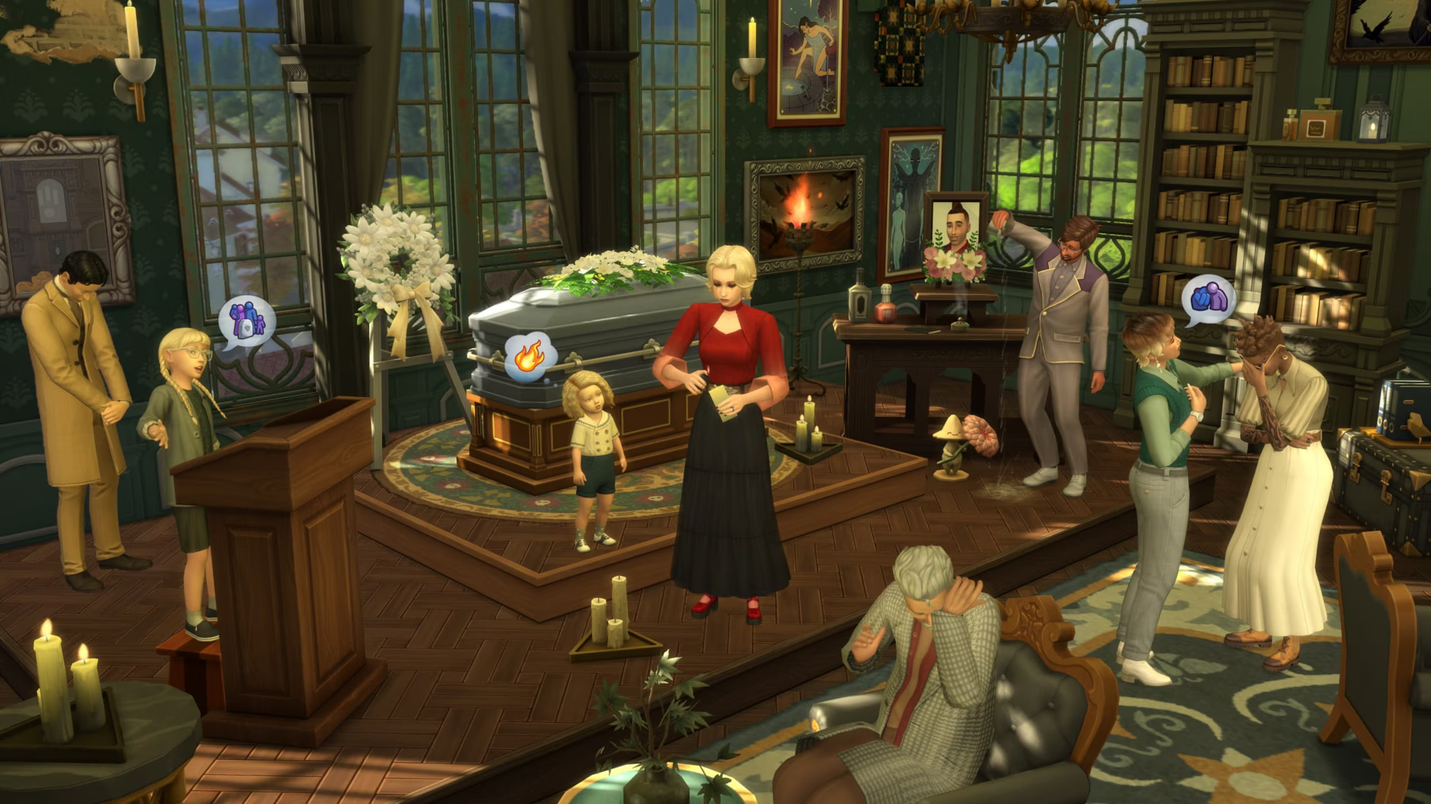
Sometimes that emotional connection inspires caretaking. Other times, it invites playful subversion. "We’re hardwired to overreact to emotionally painful moments – I want to support someone who is going through a bad time," Kauker says. "As the creator of the Sims in your world, you have that extra layer of caretaker.”
But like many people, Kauker doesn’t always treat the Sims in his sandbox with compassion. “It’s also a bit of brilliance that you can totally buck that by choice and force that sort of pain on a Sim, so you can relish the power and damage inflicted. Sometimes it feels good to destroy those hardwired instincts… says every player who has ever killed a Sim…lol”
For Kathryn, she sees human fidelity in the ‘Cringe’ trait. “OMG… I saw it and couldn't stop watching and laughing, it's incredible.”
"We aim for an honest, sincere version of real life," says Ondyak. "That’s what people relate to. They see their own lives reflected in the animations."
Tiny cues, big feelings
In a medium where storytelling often relies on dialogue, The Sims takes a different approach. Its emotional language is built from movement, tone and intricately crafted performances that encourage players to fill in the narrative for themselves.
Every player brings their own interpretation to what unfolds on screen. The same hug, the same argument, or the same moment of quiet grief can land differently depending on the story they’re imagining. This open-endedness is what makes The Sims so enduring, and so personal.
For the developers, it’s rewarding to see how deeply their performances resonate. "Sometimes I feel like I’ve helped create an internal soundtrack for so many people," says Kauker. He’s referring to the brief, distinctive musical cues – often just a few notes – that play whenever a Sim’s emotional state changes, signalling to players that something important has shifted. "When people meet me and find out what I do, they’ll literally sing those Sims 4 emotion stingers to me."
It’s a reminder that even in a game without a traditional script, moments of emotion can become iconic – and that a sigh, a glance, or a rising musical cue can speak just as clearly as words.
This article appears in ACMI Guide: The Sims, which features more interviews with the creative team behind The Sims, analysis and insights from Simmers around the world.